
Clinical Trial vs Real-World Outcome Calculator
How Real Patients Change Outcomes
This tool demonstrates why clinical trial results often differ from real-world experiences. Enter patient characteristics to see how they impact treatment effectiveness.
When a new drug hits the market, you hear about its success in clinical trials-90% response rate, 50% reduction in symptoms, near-perfect safety profile. But then you see someone on social media say, ‘I took it and it did nothing, plus I felt awful.’ What’s going on? The gap between clinical trial data and real-world outcomes isn’t a glitch-it’s the norm. And understanding this difference isn’t just for doctors or researchers. It affects every patient who takes a prescription, every insurer who pays for it, and every policymaker deciding what gets covered.
Why Clinical Trials Don’t Reflect Real Life
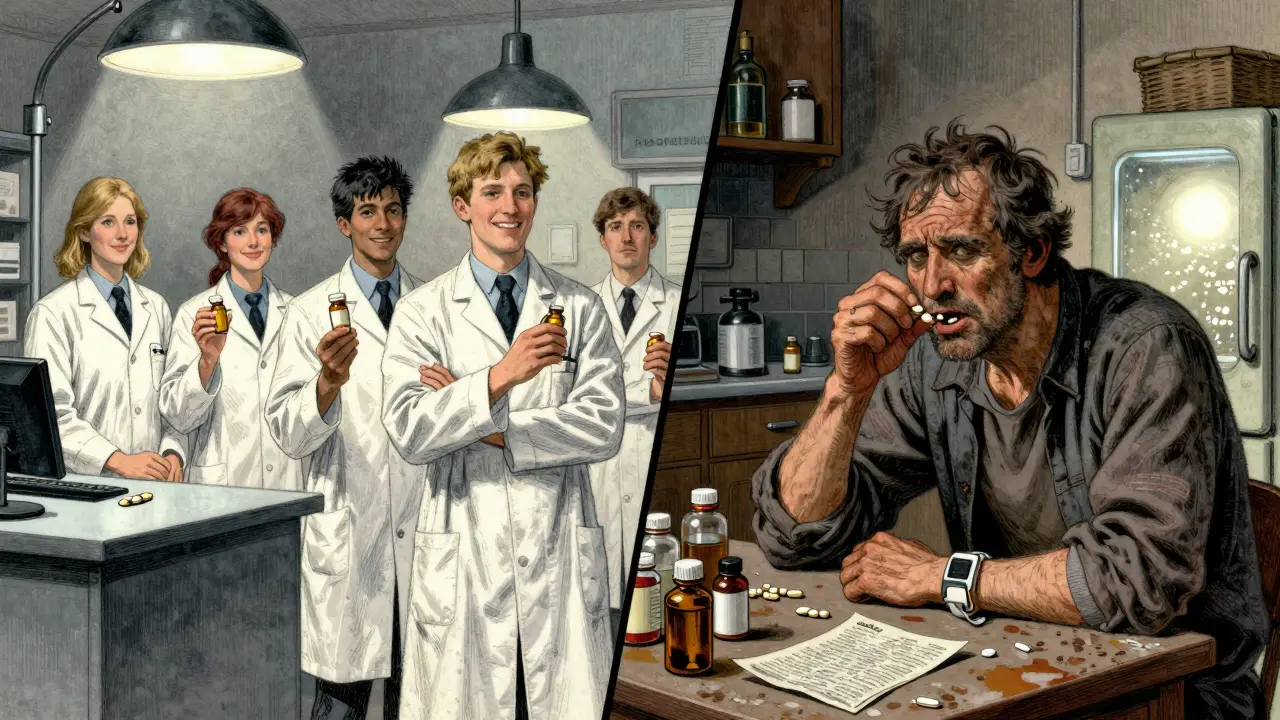
Clinical trials are designed to answer one question: Does this treatment work under perfect conditions? To get a clean answer, researchers control everything. Participants are carefully selected. They’re mostly young, healthy, with one main condition and no other serious illnesses. They’re closely monitored. They take the drug exactly as instructed. They show up for every check-up. They don’t miss doses. They don’t have jobs that stress them out. They don’t skip meals. They’re not homeless. They’re not elderly. They’re not Black or Latino in disproportionate numbers. A 2023 study in the New England Journal of Medicine found that only 1 in 5 cancer patients in U.S. academic centers would qualify for a typical clinical trial. Black patients were 30% more likely to be excluded-not because their cancer was worse, but because they were more likely to have other health issues, live far from trial sites, or lack transportation. These aren’t edge cases. They’re the majority of real patients. In contrast, real-world outcomes look at what happens when the drug leaves the lab and enters everyday life. Someone with diabetes, heart disease, and depression takes the new medication. They forget to take it on busy days. They can’t afford the copay. They start it on a Friday and don’t see their doctor for six weeks. Their blood sugar fluctuates because they ate Thanksgiving dinner. Their wearable tracker shows their heart rate spiked after a stressful call with their landlord. None of this gets recorded in a trial. But it all matters.The Data Isn’t the Same-And It Never Will Be
Clinical trial data is collected like a lab experiment: fixed intervals, standardized tools, perfect records. Real-world data? It’s messy. It comes from electronic health records, insurance claims, pharmacy logs, even fitness trackers. It’s collected when it’s convenient-not when a protocol says so. A 2024 study in Scientific Reports compared 5,734 patients from clinical trials with 23,523 from real-world records. The results were stark:- Completeness of data: 92% in trials vs. 68% in real-world records
- Time between measurements: Every 3 months in trials vs. every 5.2 months on average in real life
- Population health: Trial patients were significantly healthier across the board
Real-World Evidence Isn’t Just a Backup-It’s a Bridge
Real-world evidence (RWE) isn’t here to replace clinical trials. It’s here to answer the question trials can’t: Does this work for people like me? Take oncology. Cancer drugs cost hundreds of thousands of dollars. Trials are small, expensive, and slow. But real-world data from Flatiron Health-aggregating records from 2.5 million cancer patients across 280 clinics-shows how drugs perform in patients with multiple conditions, older adults, and those who can’t tolerate aggressive treatment. That’s not noise. That’s insight. Pfizer’s health economics team uses RWE to predict who’s most likely to stick with a drug. ObvioHealth found that by using real-world history-like past medication adherence or hospital visits-they could recruit trial participants who were 25% more likely to complete the study. That means faster trials, lower costs, and results that better reflect the people who’ll actually use the drug. The FDA has approved 17 drugs since 2019 using real-world data as part of the approval process. The European Medicines Agency uses it even more. Insurers like UnitedHealthcare and Cigna now require RWE to prove a drug is worth covering. Why? Because they’re tired of paying for treatments that look great on paper but fail in practice.
The Catch: Real-World Data Is Easy to Misuse
Just because data is real doesn’t mean it’s reliable. Real-world studies are full of hidden biases. Patients who get a new drug might be healthier, wealthier, or more motivated than those who don’t. That’s not because the drug works better-it’s because who gets access isn’t random. Dr. John Ioannidis from Stanford warned in JAMA that enthusiasm for RWE has outpaced its science. He pointed to studies where real-world data claimed a drug was effective, while the original trial showed it wasn’t. The difference? Unmeasured confounders-things like income, education, access to care-that weren’t accounted for. That’s why RWE needs strong methods. Propensity score matching. Machine learning models. Statistical adjustments. These aren’t buzzwords. They’re necessary tools. The NIH says RWE doesn’t need to follow trial protocols to be reliable-but it *does* need meticulous data cleaning and analysis. And it’s not cheap. Building a system like Flatiron Health took 5 years and $175 million. Most clinics don’t have that kind of budget. Only 35% of healthcare organizations have a dedicated team to analyze real-world data. Data is stuck in 900+ incompatible electronic health record systems. Privacy laws like HIPAA and GDPR make sharing hard. So while the potential is huge, the infrastructure is still catching up.What’s Next? The Hybrid Future
The future isn’t clinical trials or real-world evidence. It’s clinical trials and real-world evidence. The FDA’s 2024 draft guidance on hybrid trials is a game-changer. These designs start with a traditional trial to prove safety and initial effectiveness. Then, they seamlessly collect real-world data from the same patients after approval. That way, you get the rigor of a trial and the richness of real life in one study. The NIH’s HEAL Initiative is using RWE to find alternatives to opioids-something trials alone can’t do fast enough. Google Health showed AI can predict treatment outcomes from EHR data with 82% accuracy-better than traditional trial analysis. And the VALID Health Data Act, passed in 2022, is pushing for standards. If you’re going to use real-world data to make decisions, you need to prove the data is trustworthy. Transparency matters. Reproducibility matters. Too many RWE studies can’t be replicated-just 39% in one 2019 Nature study.


Write a comment