
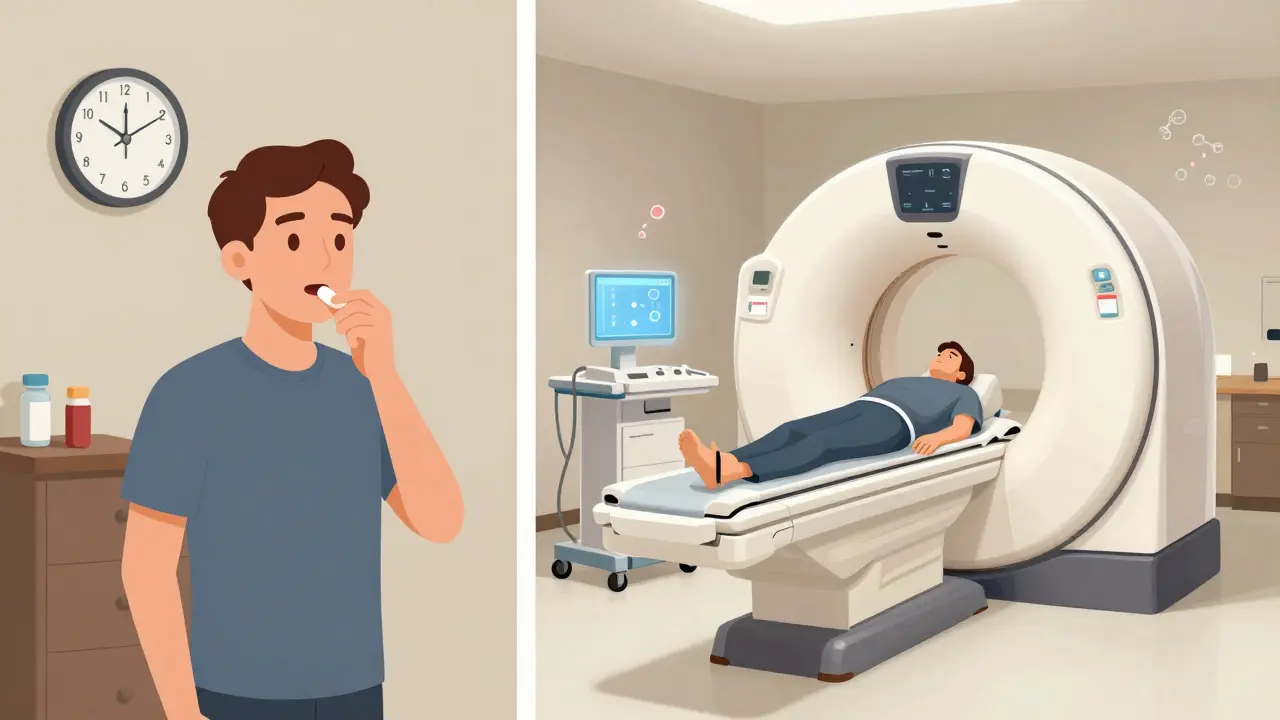
When you get a CT scan or an X-ray with contrast dye, the goal is clear: see inside your body clearly. But for some people, that simple procedure carries a hidden risk - a reaction to the dye. These reactions aren’t common, but when they happen, they can be serious. That’s why pre-medication and safety planning aren’t optional. They’re essential for anyone who’s had a prior reaction or is at higher risk.
What Exactly Is a Contrast Dye Reaction?
Contrast dye, usually iodinated, is injected into your vein to make blood vessels, organs, and tissues stand out on imaging scans. Most people tolerate it just fine. But about 0.04% to 0.22% of patients have some kind of reaction. Severe reactions - like trouble breathing, low blood pressure, or swelling of the throat - happen in roughly 1 in every 2,500 to 10,000 cases.These aren’t true allergies in the way you might think of a peanut allergy. They’re more like anaphylactoid reactions - your body overreacts without involving IgE antibodies. That’s why people with shellfish or iodine allergies aren’t automatically at higher risk. A shellfish allergy doesn’t mean you’re allergic to contrast dye. The same goes for Betadine or iodine-based skin cleansers. That’s a myth that’s been debunked by major medical centers like UCSF and UCLA.
Who Needs Pre-Medication?
Not everyone needs it. The biggest red flag? A past reaction to the same type of contrast dye. If you had a rash, itching, or nausea before, your chance of having another reaction jumps to about 35%. That’s where pre-medication comes in.Doctors classify prior reactions into three levels:
- Mild: Skin rash, mild nausea, sneezing. Most guidelines say no pre-medication is needed.
- Moderate: Vomiting, hives, wheezing, or swelling. Pre-medication is often recommended.
- Severe: Drop in blood pressure, trouble breathing, cardiac arrest. Contrast should be avoided unless it’s life-saving. Even then, it’s done with extreme caution.
Some centers, like Mount Sinai, suggest pre-medication even for moderate reactions if there’s a risk of contrast leaking into the abdomen (like in a peritoneal leak). But the standard approach, backed by Yale and UCSF, is to avoid pre-medication for mild reactions. Why? Because the risk of recurrence is low, and the meds themselves carry side effects.
The Two Main Premedication Regimens
There are two main ways to give pre-medication: oral and IV. The choice depends on whether you’re coming in for a scheduled scan or if it’s an emergency.Oral Regimen (for planned scans):
- Prednisone 50 mg by mouth - at 13 hours, 7 hours, and 1 hour before the scan
- Diphenhydramine (Benadryl) 50 mg by mouth - 1 hour before the scan
This is the classic protocol used at Dartmouth-Hitchcock and other academic centers. But here’s the catch: Benadryl makes you sleepy. You must have someone drive you home. If you don’t, your scan will be rescheduled.
IV Regimen (for emergencies or inpatients):
- Methylprednisolone 40 mg IV - given right away, then every 4 hours until scan time
- OR Hydrocortisone 200 mg IV - same schedule
- Diphenhydramine 50 mg IV - 1 hour before contrast
IV meds work faster and are used when there’s no time for oral doses. They’re common in the ER or for patients already hospitalized.
What If You Don’t Have 13 Hours?
The old 13-hour rule isn’t always practical. What if you’re admitted at 8 p.m. and need a CT at 7 a.m.? Waiting 13 hours isn’t possible.That’s where the 5-hour accelerated regimen comes in. A 2017 study in Radiology showed this works just as well:
- Methylprednisolone 32 mg by mouth - at 5 hours and 1 hour before the scan
- Diphenhydramine 50 mg by mouth - 1 hour before
This is now widely accepted in urgent care and trauma settings. It’s not perfect - it’s based on fewer studies - but it’s better than no protection at all. The key is timing: anything less than 4 to 5 hours doesn’t work. The steroids need time to reduce inflammation.
What About Kids?
Children aren’t just small adults. Their dosing is different.For kids 6 years and older who need antihistamine-only premedication (usually for mild prior reactions), UCSF recommends:
- Cetirizine 10 mg by mouth - 1 hour before the scan
For younger kids, or if steroids are needed, doses are calculated by weight. Always check with pediatric radiology - never guess.
It’s Not Just About the Meds
Premedication is only half the story. Safety planning is the other half.Major hospitals like UCSF and UCLA require that patients with a history of severe reactions be scanned at facilities with immediate access to emergency teams. That means places like Moffitt-Long Hospital or Mission Bay - not a small outpatient center without crash carts.
Also, the doctor who ordered your scan must consult with a radiologist before scheduling. This isn’t bureaucracy. It’s risk management. If you’ve had a severe reaction before, your scan needs to happen where they can handle it.
And don’t forget documentation. Your chart must clearly state your reaction history, what meds you took, and when. If you’re transferred between hospitals, that info needs to travel with you.
What If You Still React?
Even with all the right meds, about 2% of premedicated patients still have a reaction. That’s called a “breakthrough” reaction. It’s rare, but it happens.That’s why every imaging suite - even in outpatient clinics - must have emergency equipment ready: oxygen, IV fluids, epinephrine, and staff trained to use them. The Joint Commission requires this. No exceptions.
And here’s something important: if you’ve had a reaction to one type of iodinated contrast, switching to a different brand within the same class can reduce your risk as much as premedication. Yale Radiology says this is often the best first step. If you had a reaction to Omnipaque, try Iohexol next time. It’s not a guarantee, but it’s a smart move.
Why This Matters Today
The contrast dyes we use now - low-osmolar agents - are much safer than the old high-osmolar ones. Reactions have dropped by more than 80% since the 1990s. That’s why some experts are questioning whether premedication is still needed for everyone.The American College of Radiology’s next manual, expected in late 2024, is likely to shift focus from blanket premedication to personalized strategies: switching agents first, premedicating only when truly needed. The old rule - “always premedicate if you had a reaction” - is fading.
But for now, the protocols are still standard. And they work. Studies show premedication cuts recurrence rates from 35% down to about 2%. That’s a 94% reduction. That’s worth the extra step.
Cost and Accessibility
Don’t worry about the cost. A single prednisone pill costs about 25 cents. Benadryl is 15 cents. The whole premedication course is under $1. Compare that to a $1,000 CT scan. The real cost is time - scheduling, waiting, arranging rides. But the risk of skipping it? Far higher.Most academic hospitals follow these guidelines exactly. Community hospitals? About 78% do. That means if you’re getting scanned at a smaller clinic, you should ask: “Do you follow ACR guidelines for contrast reactions?” If they don’t know, that’s a red flag.
Final Thoughts
Contrast dye reactions are rare, but they’re real. Pre-medication isn’t a one-size-fits-all fix. It’s a tool - used wisely, it keeps you safe. Used blindly, it gives false confidence.If you’ve had a reaction before, speak up. Tell your doctor. Ask about switching contrast agents. Ask if you need premedication. Ask if the facility is equipped for emergencies. Don’t assume it’s all handled for you.
The goal isn’t to avoid scans. It’s to get them safely. With the right planning, you can get the answers your body needs - without putting your life at risk.


Write a comment