
Why Your Medicine Might Go Bad Before the Expiration Date
You check the bottle. The expiration date is still months away. So you assume it’s safe to use. But what if the heat in your bathroom or the humidity in your kitchen already ruined it? Medications don’t just expire on a calendar-they can break down long before that date if they’re stored in the wrong place. Heat and humidity don’t just make you uncomfortable. They actively destroy the chemical structure of pills, liquids, and injections, making them less effective-or even dangerous.
What Really Happens When Medications Get Too Hot or Wet
Pharmaceutical companies test drugs under strict conditions: 20-25°C (68-77°F) and 35-65% humidity. That’s the baseline for their expiration dates. But if you leave your medicine in a hot car, on a windowsill, or inside a steamy bathroom, you’re pushing it far beyond those limits.
Heat causes chemical reactions to speed up. That means active ingredients break down faster. Moisture does something even sneakier: it seeps into tablets and capsules, changing how they dissolve in your body. A pill meant to release medicine slowly over 12 hours might dump it all at once. That can cause side effects-or worse, make the drug useless when you need it most.
Some Medicines Are Way More Sensitive Than Others
Not all meds react the same way. Solid pills like ibuprofen or statins are fairly tough. Even after weeks in 30°C heat, they often keep 90% of their strength. But other drugs? They’re fragile.
- Insulin loses up to 20% of its potency after just 24 hours at 37°C (98.6°F). That’s body temperature. If you carry it in your purse on a hot day, it’s already weakening.
- Nitroglycerin, used for heart attacks, breaks down rapidly above 25°C. A degraded dose might not stop chest pain when you need it.
- Antibiotics like amoxicillin suspension lose 30-40% of their strength within 72 hours at room temperature. That doesn’t just mean it won’t work-it could help bacteria become resistant.
- EpiPens can fail mechanically if exposed to temperatures above 30°C. The spring mechanism gets sticky. The needle might not fire.
- Inhalers can explode if left in a car where temperatures hit 49°C (120°F). The propellant expands under pressure.
- Biologics like monoclonal antibodies for cancer or autoimmune diseases need refrigeration. If they warm up even once, their protein structure collapses. No recovery. No second chances.
Where You’re Probably Storing Medicine Wrong
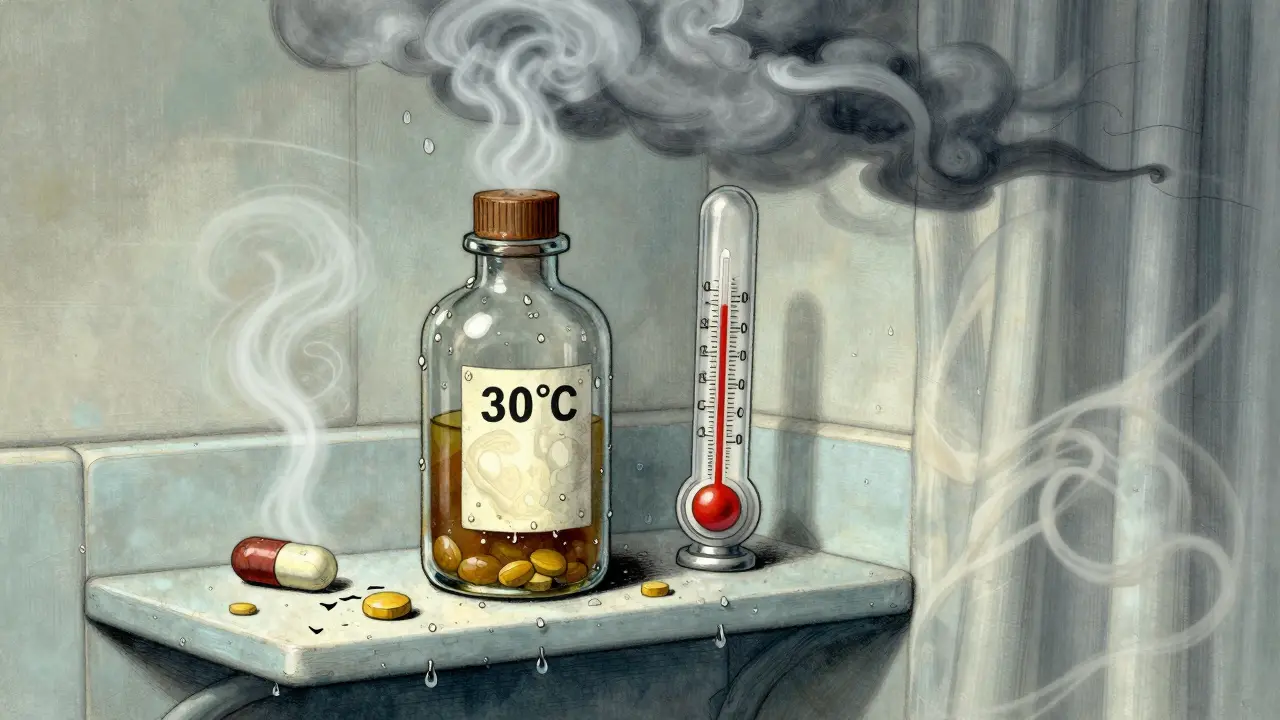
The bathroom medicine cabinet? That’s the worst place. Showers spike humidity to 70-90%. Every time you turn on the water, your pills get a steam bath. The heat from the shower also pushes temperatures above 30°C.
The kitchen isn’t much better. Near the stove, sink, or dishwasher, temperatures regularly hit 32°C (90°F). Humidity climbs above 60%. That’s enough to ruin capsules, cause tablets to stick together, or make liquid medicines cloudy.
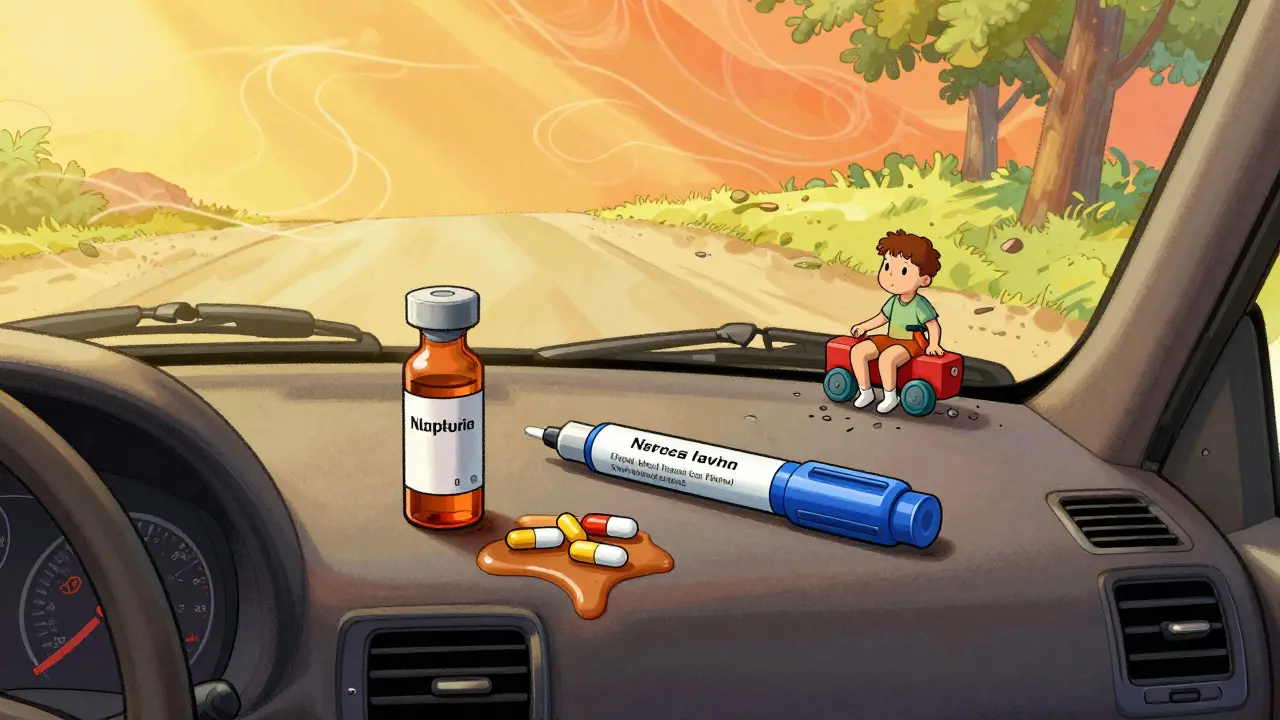
And don’t forget the car. On a sunny day, even with the windows cracked, the inside of a car can hit 60°C (140°F). That’s not just hot-it’s destructive. Medications left there for an hour can be permanently damaged.
How to Tell If Your Medicine Has Been Damaged
You can’t always tell just by looking. But there are signs:
- Tablets that are discolored, cracked, or sticky
- Capsules that are softened, leaking, or chipped
- Liquids that are cloudy, discolored, or have particles
- Unusual smells-like vinegar from degraded aspirin
- Pills that crumble easily or won’t dissolve in water like they used to
Aspirin exposed to moisture breaks down into salicylic acid and acetic acid. That’s vinegar. And while it might not kill you, it can irritate your stomach more than the original pill. For life-saving drugs like insulin or epinephrine, you don’t get a second chance.
How to Store Medicine the Right Way
Here’s what works:
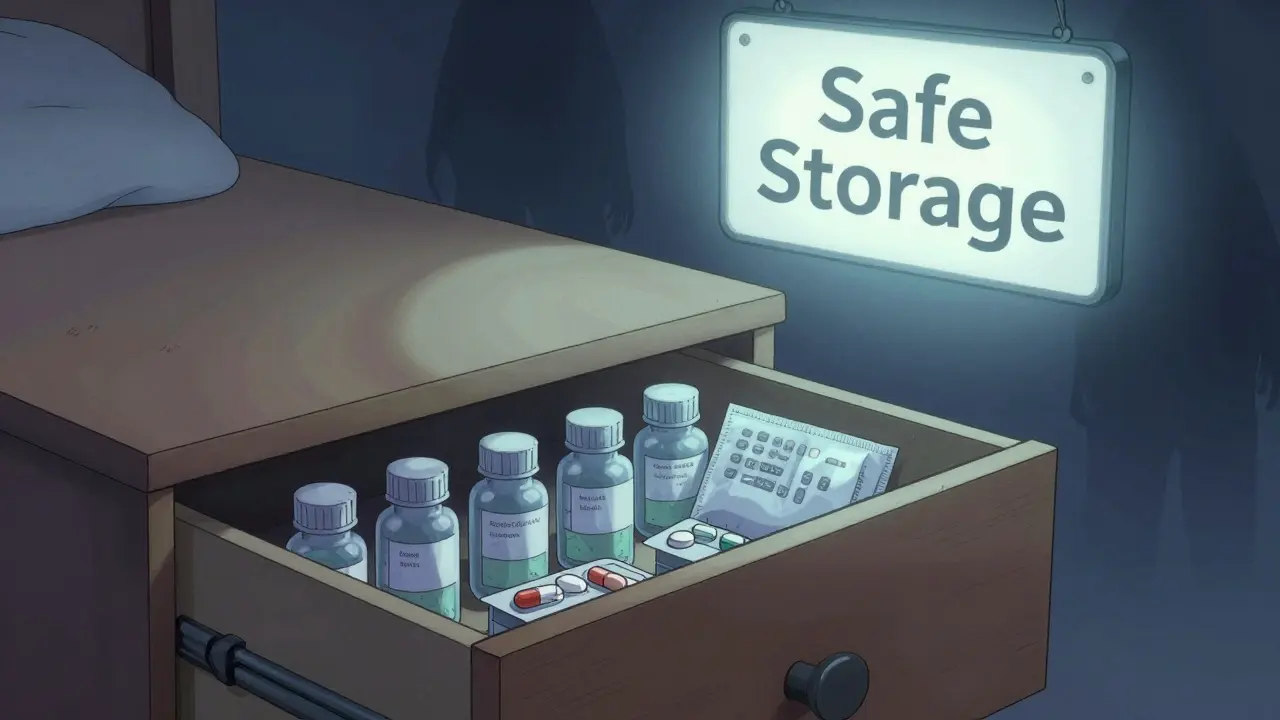
- Keep it cool. A bedroom drawer, a closet shelf, or a cabinet away from windows is ideal. Room temperature between 15-25°C (59-77°F) is the sweet spot.
- Keep it dry. No bathrooms. No kitchens. No basements. Use a sealed container with a silica gel packet if you’re worried about humidity.
- Keep it dark. Sunlight breaks down some drugs. Use original bottles-they’re usually opaque.
- Keep it sealed. Tight caps prevent moisture from sneaking in. Don’t transfer pills to pill organizers unless you’re using them immediately.
- Travel smart. For trips, carry insulin or other sensitive meds in a small cooler with a cold pack. Pharmacies sell reusable cooling packs designed for this.
Why This Matters More Than You Think
Using degraded medicine isn’t just ineffective-it’s risky. If your antibiotic doesn’t kill all the bacteria, the survivors become stronger. That’s how antibiotic resistance grows.
For diabetics, weak insulin means high blood sugar. That leads to nerve damage, kidney failure, vision loss. For someone with heart disease, a failed nitroglycerin tablet could mean a heart attack. An EpiPen that doesn’t work? That’s a death sentence during anaphylaxis.
The FDA says it plainly: "Using expired medicines is risky and possibly harmful to your health." That warning applies even if the date hasn’t passed. If the storage conditions were bad, the date is meaningless.
What’s Changing in the Industry
Pharmacies are starting to respond. More medications now come with desiccants inside the bottle. Some have temperature-sensitive labels that change color if exposed to heat. Others are being packaged in better-insulated containers.
Future tech might include smart pill bottles with Bluetooth sensors that alert you if the temperature went too high. But until then, you’re the first line of defense.
And here’s the hard truth: climate change is making this problem worse. Heat waves are longer. Humidity is rising. In places like Wellington, where summers are getting warmer, even indoor storage can cross dangerous thresholds. The World Health Organization now lists medication stability in hot climates as a growing public health threat.
What to Do If You’re Not Sure
When in doubt, don’t use it. Call your pharmacist. They can tell you if the medication is still safe based on its type, appearance, and storage history. Most pharmacies will replace expired or damaged prescriptions for free, especially if it’s a critical drug.
Don’t flush old meds unless instructed. Don’t throw them in the trash where kids or pets might find them. Many pharmacies offer take-back programs. Ask about them.
Bottom Line
Expiration dates aren’t magic. They’re only valid if your medicine was stored properly. Heat and humidity don’t wait for the date to pass-they start working the moment your pills leave the cool, dry pharmacy shelf. If you want your medicine to work when you need it, treat it like a fragile tool, not a disposable item. Store it right. Check it often. And when in doubt, replace it.


Write a comment