
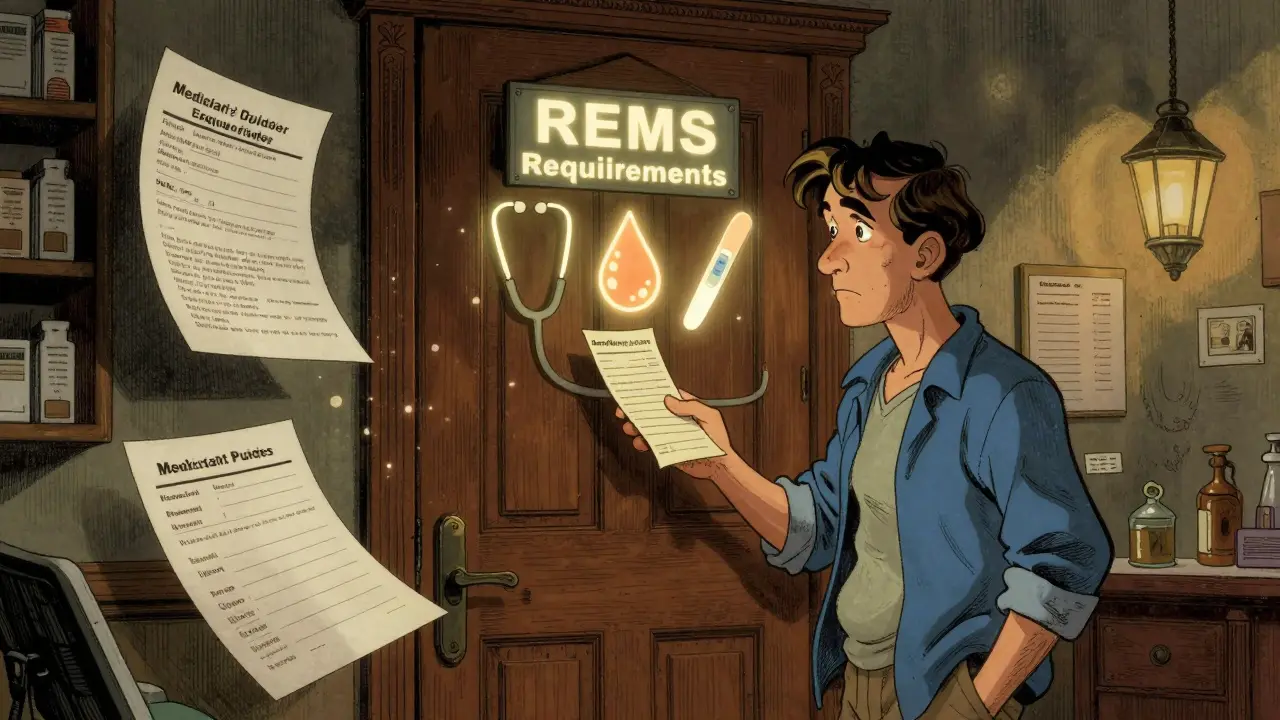
Starting a new medication isn’t just about picking up a prescription. If that drug has serious risks, you might be stepping into a safety system called REMS-Risk Evaluation and Mitigation Strategies. These aren’t optional guidelines. They’re legally required safety nets put in place by the FDA to make sure the benefits of certain drugs outweigh their dangers. Ignoring REMS requirements can delay your treatment, put you at risk, or even lead to a pharmacy refusing to fill your prescription. Here’s exactly how to check them before you take that first dose.
What Is REMS and Why Does It Matter?
REMS stands for Risk Evaluation and Mitigation Strategies. It’s a system the FDA created after the Food and Drug Administration Amendments Act of 2007 to manage serious safety risks tied to certain medications. Think of it like a safety checklist that doctors, pharmacists, and patients must follow before and during treatment.
Not all drugs need REMS. But if your medication is linked to life-threatening side effects-like birth defects, severe allergic reactions, addiction, or sudden death-it’s likely under a REMS program. As of 2026, there are 76 active REMS programs in the U.S. covering drugs for conditions like cancer, epilepsy, severe acne, opioid pain, and autoimmune diseases.
Without REMS, some of these drugs wouldn’t be approved at all. The system lets the FDA approve treatments that could save lives, while still protecting patients from known dangers. But it also adds steps. And if you don’t know about them, you’ll hit a wall.
How to Find Out If Your Medication Has a REMS Program
The first thing you need to do is confirm whether your drug is covered by a REMS. Don’t assume it’s not. Don’t rely on your doctor’s memory. Here’s how to check for sure.
Start with the prescribing information-the official document that comes with the drug. It’s usually included in the packaging or available online through DailyMed. Look for a section titled “REMS” or “Risk Evaluation and Mitigation Strategy.” If it’s there, you’re dealing with a REMS drug.
Next, go to the FDA’s official REMS Public Dashboard. This free, searchable tool lists every active REMS program. Type in the brand or generic name of your medication. If it shows up, you’ll see the full list of requirements: whether prescribers need certification, if patients must enroll in a registry, or if the drug can only be given in a certified facility.
Third, check the manufacturer’s website. Most companies have a dedicated REMS page. For example, isotretinoin (Accutane) uses the iPLEDGE program. Thalidomide and lenalidomide use the Revlimid REMS site. These sites have enrollment forms, training videos, and step-by-step instructions.
Finally, call your pharmacy. Pharmacists are on the front lines of REMS verification. If they see a REMS drug in your prescription, they’ll flag it. Ask them: “Does this medication require any special steps before I can fill it?” They’ve seen it all.
What REMS Requirements You Might Face
Not all REMS programs are the same. They vary based on the drug’s risk. There are four main types of requirements you might encounter.
- Medication Guides: These are printed handouts you get every time you fill the prescription. They explain the risks in plain language. You must read and sign for them. Keep them. They’re part of your medical record.
- Communication Plans: These are training materials sent to doctors and pharmacists. You won’t see them directly, but your provider should be trained. Ask them: “Have you completed the required REMS education for this drug?”
- Elements to Assure Safe Use (ETASU): These are the strictest rules. They might include:
- Prescriber certification: Your doctor must register and complete training before prescribing.
- Patient enrollment: You must sign up in a national registry (like iPLEDGE for isotretinoin).
- Lab tests: Monthly blood tests or pregnancy tests might be required.
- Restricted distribution: The drug can only be dispensed by certified pharmacies or administered in certified clinics.
For example, Zyprexa Relprevv (an antipsychotic injection) can only be given in certified clinics because it can cause sudden drowsiness or confusion after injection. You’ll need to stay for three hours after each shot. Vyvanse, a stimulant for ADHD, requires prescriber certification and patient education-though not a registry. Mycophenolate, used after organ transplants, requires pregnancy testing and counseling for women of childbearing age.

What to Do If Your Drug Has a REMS Program
Once you know your medication has REMS requirements, here’s your action plan.
- Confirm the prescriber is certified. Call your doctor’s office. Ask: “Are you enrolled in the REMS program for [drug name]?” If they’re not, they can’t legally prescribe it. Some require online training that takes 30 to 90 minutes.
- Check if you need to enroll. If it’s a patient registry like iPLEDGE, you’ll get an email or letter with a link to register. You’ll need your ID, insurance info, and sometimes proof of negative pregnancy tests. Don’t ignore this step-it can take 2-5 business days.
- Prepare for lab tests or monitoring. If your drug requires monthly blood work or pregnancy tests, schedule those before your first prescription. Some pharmacies won’t fill the script without recent lab results.
- Know where you can get the drug. Some REMS drugs are only available at specialty pharmacies or hospitals. Your regular CVS or Walgreens might not carry it. Ask your doctor or pharmacist where to go.
- Keep records. Save every Medication Guide, signed form, lab result, and certification number. The FDA requires these to be kept for at least 10 years. Use a folder or a photo album on your phone.
One pharmacist in a 2023 Reddit thread said they cut prescription processing time for isotretinoin from 45 minutes to 15 minutes by creating a checklist. You can do the same. Write down your REMS steps and check them off as you go.
Common Problems and How to Avoid Them
REMS programs are meant to protect you-but they often cause delays. A 2022 survey found that 42% of patients on REMS drugs faced treatment delays, averaging over six business days.
Here are the top issues-and how to dodge them.
- “My doctor didn’t know about the REMS.” Many doctors miss updates. Don’t assume they know. Bring up the FDA REMS dashboard yourself. Say: “I checked online-this drug requires certification. Can you confirm you’re enrolled?”
- “The pharmacy won’t fill it.” They might not be certified to dispense it. Ask for the nearest certified pharmacy. Use the REMS dashboard to find one near you.
- “I didn’t get the Medication Guide.” By law, you must receive it at every fill. If you don’t, refuse to take the drug and call the FDA’s MedWatch hotline.
- “I’m pregnant and I’m on a teratogenic drug.” If you’re a woman of childbearing age, REMS drugs like isotretinoin or mycophenolate require two negative pregnancy tests before starting. Don’t skip this. The risk of birth defects is real.
Also, don’t rely on apps or websites that aren’t official. The FDA’s REMS dashboard is the only trusted source. Manufacturer sites are reliable too. But blogs, forums, or pharmacy apps might be outdated.

Who’s Responsible for What?
REMS isn’t just your job. It’s a team effort.
- You: Must read the Medication Guide, complete enrollment if required, get lab tests, and follow instructions.
- Your doctor: Must be certified, complete training, order required tests, and document your enrollment.
- Your pharmacist: Must verify certification, check registries, dispense only to enrolled patients, and provide the Medication Guide.
- The manufacturer: Must maintain the REMS program, update training, provide materials, and report compliance.
If someone drops the ball, it’s your right to ask. If they refuse to comply, you can report them to the FDA’s MedWatch program. Non-compliance can lead to fines or even removal of the drug from the market.
What’s Changing in 2026?
REMS isn’t static. The FDA is actively trying to make it less burdensome without sacrificing safety.
In 2023, the FDA updated its REMS dashboard to show real-time changes. It now includes filters for ETASU requirements, patient enrollment status, and pharmacy certification. By 2026, new REMS programs must include smartphone-friendly tools-like apps or SMS alerts-to help patients track requirements.
Pharmacy benefit managers (PBMs) are now integrating REMS checks directly into e-prescribing systems. That means your doctor’s system might auto-flag a REMS drug and prompt them to complete certification before sending the prescription.
Experts predict that by 2026, blockchain technology will be tested in REMS systems to securely track prescriber certifications and patient enrollments across multiple providers. This could cut delays by up to 50%.
For now, the system still has gaps. But knowing how to navigate it gives you control.
Final Checklist Before Starting Any New Medication
Use this before you take your first pill:
- ✅ Checked the FDA REMS Public Dashboard for this drug
- ✅ Confirmed your prescriber is certified
- ✅ Completed any required patient enrollment or registry
- ✅ Scheduled and completed required lab tests (pregnancy, blood work)
- ✅ Received and signed the Medication Guide
- ✅ Know where the drug can be dispensed (pharmacy or clinic)
- ✅ Saved all documents (certificates, lab reports, forms)
If you can check all these boxes, you’re ready. If even one is missing, pause. Don’t take the drug until it’s resolved. REMS isn’t bureaucracy-it’s your safety net.
What happens if I skip a REMS requirement?
Skipping a REMS requirement can be dangerous. For drugs like isotretinoin or mycophenolate, it could lead to severe birth defects. For opioids, it could increase overdose risk. Pharmacies are legally required to refuse to fill prescriptions if REMS steps aren’t completed. You may also be denied future prescriptions for that drug. In rare cases, providers who ignore REMS can face penalties from the FDA.
Do I need to do REMS steps every time I refill my prescription?
It depends. Medication Guides must be given at every refill. Patient enrollment usually only needs to be done once, unless you’re removed from the registry (e.g., after a pregnancy or if you stop the drug for over a year). Prescriber certification is valid for years, but some programs require renewal every 2-3 years. Lab tests like pregnancy checks are often required monthly or before each refill. Always check the specific REMS program rules.
Can my pharmacist tell me if my drug has a REMS program?
Yes. Pharmacists are trained to recognize REMS drugs by their NDC codes and packaging labels. They can also access the FDA REMS database through their pharmacy systems. If you ask, they should be able to tell you if your drug requires special steps-and what those steps are. Don’t hesitate to ask.
Are REMS programs only for brand-name drugs?
No. Both brand-name and generic versions of a drug are covered under the same REMS program. If the brand has a REMS, the generic does too. The FDA requires this to ensure equal safety standards. Always check the generic name on the FDA REMS dashboard.
How long does REMS certification take for prescribers?
It varies. Some require just 30 minutes of online training. Others, like the opioid REMS, take 60-90 minutes. For drugs like thalidomide, prescribers must complete accredited continuing education and pass a quiz. Certification usually lasts 2-3 years. Doctors can check their status on the manufacturer’s REMS website. Patients should ask their provider if they’re certified before starting the drug.
Is there a cost to enroll in a REMS program?
No. Enrollment in REMS programs is free for patients and prescribers. Manufacturers cover all costs for training, registration, and materials. If someone asks you to pay for REMS enrollment, it’s a scam. Always use official FDA or manufacturer websites-never third-party sites that charge fees.


Write a comment