

Lithium-NSAID Interaction Risk Calculator
This tool estimates your risk of lithium toxicity when taking NSAIDs based on kidney function, age, and NSAID type. Lithium toxicity can cause serious symptoms including tremors, confusion, and kidney damage. Always consult your doctor before making any changes to your medication regimen.
When you're managing bipolar disorder with lithium, your body is already balancing on a fine line. Lithium works, but it's not forgiving. Even small changes in how your kidneys handle it can push you into dangerous territory. Now imagine adding a common painkiller like ibuprofen or naproxen to the mix. That’s not just a minor concern-it’s a silent, high-risk combo that can land you in the hospital with kidney failure or severe neurological toxicity. This isn’t theoretical. It’s happening right now, in clinics and homes across the country, often without anyone realizing the danger.
How Lithium and NSAIDs Interact
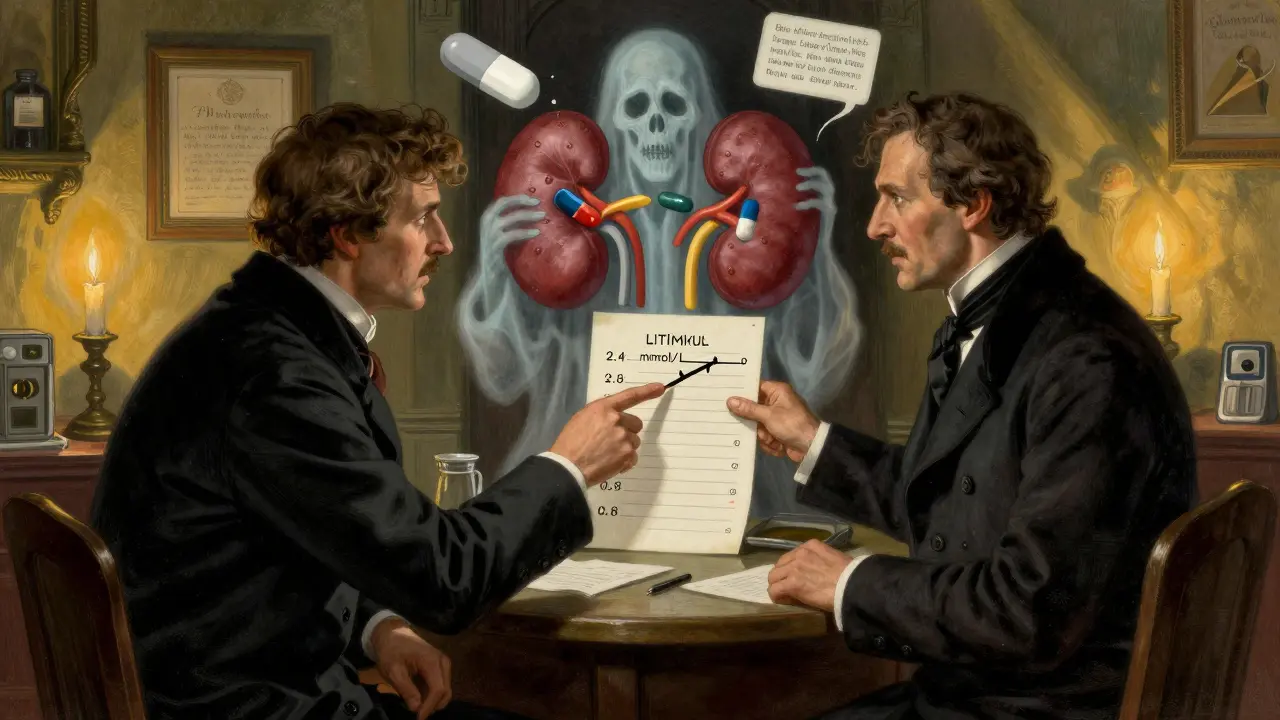
Lithium is cleared from your body almost entirely through your kidneys. Your kidneys filter lithium out of your blood and into your urine. That’s why your lithium levels need regular monitoring. But when you take an NSAID-whether it’s Advil, Aleve, or a prescription-strength version-you’re interfering with that process. NSAIDs block enzymes called cyclooxygenase (COX), which your kidneys use to make prostaglandins. These prostaglandins help keep blood flowing through the kidneys. When they’re suppressed, blood flow drops, and your kidneys start holding onto lithium instead of flushing it out.Studies show this isn’t a minor bump. NSAIDs can reduce lithium clearance by 25% to 60%. That means your blood lithium levels can spike overnight. A level that was perfectly safe at 0.8 mmol/L can jump to 1.8 mmol/L in just two days. And once it hits 1.5 mmol/L, you’re in the danger zone. Symptoms like tremors, confusion, slurred speech, and nausea start showing up. At 2.0 mmol/L or higher, seizures, coma, and permanent kidney damage become real risks.
Why Some NSAIDs Are Worse Than Others
Not all NSAIDs are created equal when it comes to lithium. Indomethacin is the worst offender, often causing lithium levels to rise by 40% to 60%. Piroxicam and diclofenac aren’t far behind. Ibuprofen and naproxen? They’re still risky, typically raising lithium by 20% to 30%. Even celecoxib (Celebrex), often called a "kidney-friendly" NSAID, can push lithium levels up by 10% to 15%-enough to be dangerous if you already have reduced kidney function.Aspirin and low-dose aspirin? They’re the exception. They barely affect lithium levels. That’s why, in clinical guidelines, aspirin is sometimes the only NSAID considered acceptable for short-term use in lithium patients-though even that requires caution.
The Double Hit on Your Kidneys
This isn’t just about lithium building up. It’s about your kidneys getting attacked from two sides.Lithium itself is nephrotoxic. Over time, it can cause chronic kidney disease by damaging the cells in the kidney tubules. It does this by disrupting a key protein called beta-catenin, which leads to scarring and reduced function. Meanwhile, NSAIDs cut off blood flow to the kidneys. That’s ischemic injury-starving kidney tissue of oxygen. When you combine these two effects, you’re not just adding risks. You’re multiplying them.
A 2023 JAMA Network Open study tracked over 12,000 patients on lithium. Those who took NSAIDs had a 3.2-fold higher risk of acute kidney injury (AKI) than those who didn’t. The highest risk? The first 30 days after starting the NSAID. And for patients over 65? The risk jumped even higher. One in every three cases of AKI linked to lithium in nephrology clinics was directly tied to NSAID use.
Who’s Most at Risk?
It’s not just about the drugs. It’s about the person.- Older adults: Kidney function naturally declines after 50. If you’re over 65, your kidneys are already working at 60-70% capacity. Adding NSAIDs can push you over the edge.
- People with existing kidney issues: If your eGFR is below 60 mL/min/1.73 m², you’re already in the danger zone. NSAIDs can cause rapid, irreversible damage here.
- Dehydrated patients: Even mild dehydration-say, from not drinking enough water, sweating in heat, or taking a diuretic-makes lithium retention worse.
- Patients seeing multiple doctors: A 2023 study found that 47.8% of lithium users who got NSAIDs had three or more prescribers. One doctor may know about your lithium. Another may not.
And here’s the scary part: many patients don’t even know they’re at risk. A national survey showed that only 58.3% of primary care doctors correctly identified NSAIDs as a high-risk interaction with lithium. That means almost half of the time, someone walks into a clinic with knee pain, gets an NSAID prescription, and no one connects the dots.
What Happens When You Don’t Know
Case reports tell the real story.In 2022, a 71-year-old woman with bipolar disorder took ibuprofen for arthritis for five days. She didn’t tell her psychiatrist. Her lithium level was normal before. After five days? It was 2.4 mmol/L. She was hospitalized with confusion, vomiting, and tremors. Her kidney function dropped by 40%. She never fully recovered.
On Reddit’s r/psychiatry, over 120 patients shared similar stories. Seventy percent described tremors, confusion, or hospitalization after combining lithium and NSAIDs. Nearly a third said their pain doctor prescribed the NSAID without asking about lithium. No warning. No monitoring. Just a prescription.
These aren’t rare outliers. They’re symptoms of a broken system. Electronic health records have alerts for this interaction. But studies show those alerts only reduce co-prescribing by 35%. Why? Because doctors often click "override" without reading the warning.
What Should You Do Instead?
If you’re on lithium and need pain relief, here’s what works-and what doesn’t.- First choice: Acetaminophen (Tylenol). It doesn’t affect lithium levels. The max daily dose is 3,000 mg (3 grams) to avoid liver damage. Stick to that limit.
- Second choice: Tramadol. It’s not perfect-some people get dizziness or nausea-but it doesn’t interfere with kidney clearance of lithium. Start at 25 mg once daily and increase slowly.
- Third choice: Short-term NSAIDs, with extreme caution. Only if nothing else works. Use the lowest effective dose for no more than 7 days. Drink at least 3 liters of water daily. Monitor lithium levels twice a week during use and for a week after stopping.
And here’s a critical point: the interaction doesn’t stop when you stop taking the NSAID. It takes 7 to 10 days for your kidneys to fully recover their ability to clear lithium. That means even after you’ve finished your painkiller, your lithium levels can still rise. Don’t assume you’re safe just because you stopped the NSAID.
What Doctors Should Be Doing
The American Society of Nephrology and the American Psychiatric Association both say the same thing: avoid this combo whenever possible. If you absolutely must use an NSAID:- Check lithium levels before starting.
- Check again at 48-72 hours after starting.
- Check kidney function (creatinine, eGFR) weekly for the first month.
- Reduce the lithium dose by 25-50% preemptively if the NSAID is strong (like indomethacin or piroxicam).
- Document the warning in the patient’s chart and give them a printed handout.
Yet a 2021 audit found that only 62.4% of lithium-prescribing clinicians included NSAID warnings in patient education materials. Compare that to 98.7% who warned about diuretics. That gap is deadly.
The Bigger Picture
This isn’t just about one drug interaction. It’s about how we treat chronic mental illness and chronic pain as separate problems. A patient with bipolar disorder often has arthritis, back pain, or migraines. They shouldn’t have to choose between emotional stability and physical comfort. But right now, the system forces that choice.The economic cost is staggering. In the U.S. alone, lithium-NSAID-related hospitalizations cost $48.7 million annually. Each episode averages $18,450. That’s money spent on ER visits, ICU stays, and long-term dialysis for patients who could have been protected.
Some systems are fixing this. Kaiser Permanente cut co-prescribing by 63% using mandatory education and hard EHR alerts. But the Veterans Health Administration saw only a 15% drop. Why? Because alerts alone aren’t enough. You need training, accountability, and culture change.
And what about the future? New drugs are being tested. A 2023 trial is exploring a prostaglandin analog that might protect kidney blood flow without affecting lithium clearance. Early results show promise. But until then, the safest option is simple: avoid NSAIDs. Use acetaminophen. Talk to your doctor. Monitor your levels.
Final Warning
Lithium saves lives. It reduces suicide risk by 44%-more than any other mood stabilizer. But it demands respect. You can’t treat it like a regular medication. It’s a precision tool. And NSAIDs? They’re like a wrench thrown into the gears.If you’re on lithium, never take an NSAID without talking to your psychiatrist or nephrologist first. If you’re a provider, assume every patient on lithium is one NSAID away from disaster. And if you’re a caregiver or family member? Learn the signs of lithium toxicity: tremors, confusion, vomiting, dizziness, muscle weakness. Act fast. A few hours can make the difference between recovery and permanent damage.
Can I take ibuprofen if I’m on lithium?
It’s not recommended. Ibuprofen can raise lithium levels by 20-30%, increasing the risk of toxicity. If you must take it, do so only for less than 7 days, drink plenty of water, and have your lithium levels checked before and 48-72 hours after starting. Always consult your psychiatrist first.
What painkiller is safe with lithium?
Acetaminophen (Tylenol) is the safest option. It doesn’t interfere with lithium clearance. The maximum daily dose is 3,000 mg to avoid liver damage. Tramadol is a second-line option if acetaminophen isn’t enough, but it should be started at low doses and monitored. Avoid all NSAIDs unless absolutely necessary and under strict medical supervision.
How long does the lithium-NSAID interaction last?
The interaction doesn’t end when you stop the NSAID. It can take 7 to 10 days for your kidneys to fully recover their ability to clear lithium. That means lithium levels can still rise after you’ve stopped taking the painkiller. Continue monitoring for at least a week after discontinuing NSAIDs.
Can NSAIDs cause permanent kidney damage with lithium?
Yes. Studies show that up to 35% of patients hospitalized for lithium toxicity due to NSAID use develop permanent kidney damage, with eGFR declines of 40% or more. This is especially common in older adults or those with preexisting kidney disease. The damage is often irreversible, even after stopping both drugs.
Why do some doctors still prescribe NSAIDs to lithium patients?
Many doctors aren’t aware of the severity of the interaction. A national survey found that only 58.3% of primary care providers correctly identified NSAIDs as high-risk for lithium users. Electronic alerts help, but they’re often overridden. Communication gaps between psychiatrists, pain specialists, and primary care doctors also contribute to the problem.
What should I do if I accidentally took an NSAID while on lithium?
Stop the NSAID immediately. Drink plenty of water. Contact your psychiatrist or go to an urgent care clinic to get your lithium level checked. If you have symptoms like tremors, confusion, vomiting, or dizziness, go to the ER. Do not wait. Lithium toxicity can escalate quickly.
Write a comment