
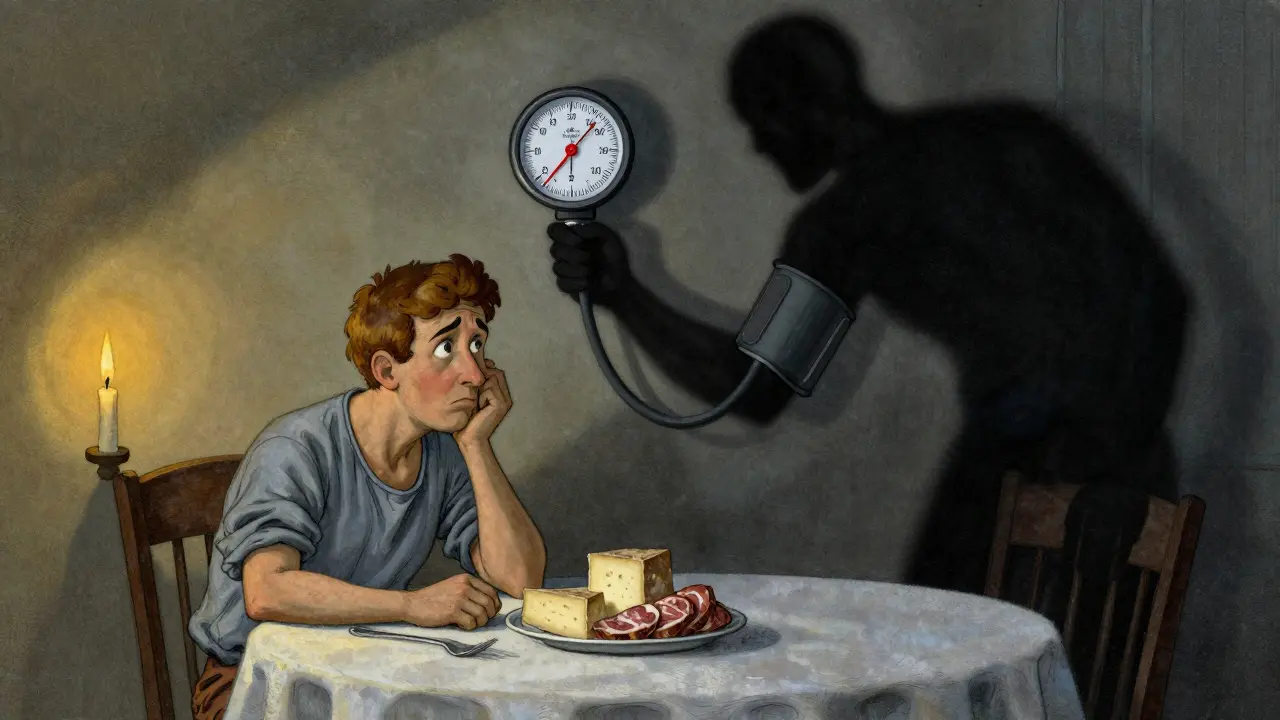
When most people think of antidepressants, they picture SSRIs like Prozac or Zoloft-easy to take, few dietary rules, and minimal side effects. But there’s another class of antidepressants that works differently, works better for some, and comes with serious, life-altering rules: Monoamine Oxidase Inhibitors, or MAOIs.
MAOIs aren’t the first choice. They’re not even the second. But for people who’ve tried five, six, or even seven other antidepressants and still feel stuck in deep depression, MAOIs can be the only thing that pulls them out. The catch? You can’t eat aged cheese. You can’t drink most beers. You can’t take common cold medicines. And if you mess up, you could end up in the emergency room with a blood pressure so high it could cause a stroke or heart attack.
How MAOIs Actually Work
MAOIs don’t just boost serotonin like SSRIs do. They block an enzyme called monoamine oxidase, which normally breaks down serotonin, norepinephrine, and dopamine. When this enzyme is turned off, these mood-lifting chemicals build up in your brain. It’s like stopping a drain from emptying a bathtub-instead of one stream, you’re getting all three at once.
This broad effect is why MAOIs work for people who don’t respond to other antidepressants. A 2021 meta-analysis in the American Journal of Psychiatry found that 50-60% of patients with treatment-resistant depression saw major improvement after starting an MAOI. That’s higher than most other drugs when everything else has failed.
There are two main types of MAOIs: irreversible ones like phenelzine (Nardil) and tranylcypromine (Parnate), and reversible ones like moclobemide (not available in the U.S.). The irreversible ones bind permanently to the enzyme. Your body has to make new enzymes-taking about two weeks-before the drug’s effect wears off. That’s why switching from an MAOI to another antidepressant requires a 2-5 week waiting period. Get it wrong, and you risk serotonin syndrome: a dangerous spike in brain chemicals that can cause seizures, high fever, or even death.
The Tyramine Trap: Why Your Cheese Matters
The biggest danger with MAOIs isn’t the drug itself-it’s what you eat. Tyramine is a natural compound found in aged, fermented, or spoiled foods. Normally, your gut uses MAO-A to break it down before it hits your bloodstream. But when MAO-A is blocked by the drug, tyramine surges into your system and forces your body to release stored norepinephrine. That causes your blood pressure to skyrocket-sometimes over 200 mmHg.
You don’t need to be an expert to avoid this. Just follow these rules:
- Avoid aged cheeses: cheddar, parmesan, blue cheese, gouda-all high in tyramine. Fresh cheeses like cottage cheese, ricotta, and mozzarella are safe.
- No cured or smoked meats: salami, pepperoni, pastrami, and hot dogs are risky. Fresh chicken, fish, or ground beef are fine.
- Stay away from tap beer, homebrew, and aged wines. Bottled beer and most wines in moderation are okay.
- Don’t eat soy sauce, miso, tempeh, or fermented tofu. Tamari (low-sodium soy sauce) is safer but still risky.
- Skip overripe fruits, fava beans, and yeast extracts like Marmite.
It sounds extreme, but the numbers back it up. A 2022 study in the Journal of Clinical Psychiatry found that 28% of MAOI users had at least one hypertensive episode in their first year-often from a single meal they didn’t realize was dangerous. One Reddit user shared: “I ate a slice of blue cheese on a sandwich and ended up in the ER with BP 220/110. I thought I was having a panic attack. It was a hypertensive crisis.”
Drug Interactions You Can’t Afford to Ignore
MAOIs don’t just clash with food-they clash with common medications. Even over-the-counter stuff can be deadly.
- SSRIs and SNRIs: Mixing them with MAOIs causes serotonin syndrome. You need a 2-5 week gap between stopping one and starting the other.
- Decongestants: Pseudoephedrine (Sudafed), phenylephrine, and even some nasal sprays can trigger dangerous spikes in blood pressure.
- Painkillers: Meperidine (Demerol) is a known killer when mixed with MAOIs. Tramadol and dextromethorphan (in cough syrup) also carry risk.
- Herbal supplements: St. John’s wort, 5-HTP, and L-tryptophan can all push serotonin levels too high.
A 2022 study in the Journal of Clinical Psychopharmacology found that 15-20% of serotonin syndrome cases linked to MAOIs happened because patients didn’t wait long enough between switching antidepressants. Many doctors still don’t warn patients properly. That’s why the FDA requires a black box warning-the strongest safety alert-for all MAOIs.
The Patch That Changed Everything
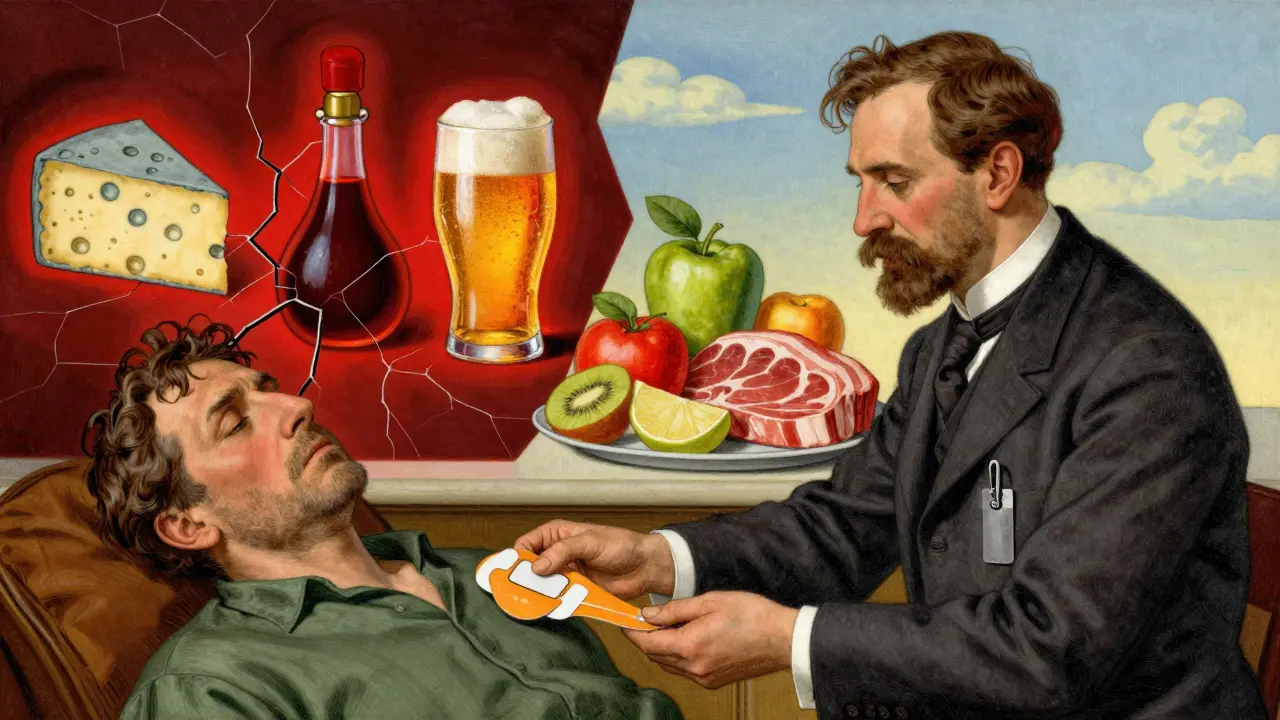
Not all MAOIs are created equal. The transdermal selegiline patch (Emsam) is a game-changer. Instead of swallowing a pill, you stick a patch on your skin. At the lowest dose (6 mg/24 hours), you don’t need to change your diet at all. At higher doses, restrictions kick in-but even then, only 8% of users need full dietary changes, compared to 92% with oral MAOIs.
This is why Emsam is growing in popularity. It’s expensive-$850 to $1,200 a month-but for people who travel often, eat out regularly, or just can’t handle the mental load of food tracking, it’s worth it. A 2023 FDA review confirmed its safety profile at low doses, making it the only MAOI that can be prescribed without a strict tyramine diet.
Who Really Benefits?
MAOIs aren’t for everyone. But they’re life-changing for specific groups:
- Atypical depression: People who sleep too much, gain weight, feel heavy in their limbs, and are hypersensitive to rejection. MAOIs are the most effective treatment for this subtype-better than SSRIs.
- Treatment-resistant depression: After failing three or more other antidepressants, MAOIs offer the best shot at remission.
- People who can’t tolerate SSRIs: If you get nausea, sexual side effects, or emotional numbness from SSRIs, MAOIs often feel more natural.
A 2023 Lancet Psychiatry meta-analysis found MAOIs had a number needed to treat (NNT) of 4.2 for atypical depression-meaning only four people need to take it for one to fully recover. For SSRIs, the NNT was 7.8. That’s a big difference.

The Real Cost: Lifestyle, Not Just Money
The biggest hurdle isn’t the price. It’s the mental burden.
Imagine being on a date and having to explain why you can’t have soy sauce. Or packing your own food for a family dinner because you don’t trust the kitchen. Or checking every expiration date on your groceries. One user on Reddit said: “I stopped dating for two years because I was terrified I’d accidentally kill myself.”
And it’s not just food. You have to tell every doctor, pharmacist, and ER nurse you see that you’re on an MAOI. Even a simple flu shot or dental anesthetic can carry risk if you’re not upfront.
Yet, 65% of MAOI users in a 2022 Depression and Bipolar Support Alliance survey stayed on the medication for over two years-even with all the restrictions. Why? Because they finally felt like themselves again.
What’s Next for MAOIs?
Research is moving fast. A new experimental MAO-A inhibitor, AZD7325, showed a 70% reduction in tyramine sensitivity in early trials. The National Institute of Mental Health is funding studies on MAOIs for bipolar depression-with promising early results.
For now, MAOIs remain a last-resort tool. But they’re not outdated. They’re underused. As Dr. Charles Nemeroff put it: “The fears about MAOIs are often exaggerated. With proper education, they’re safe-and for some, they’re the only thing that works.”
If you’ve tried everything else and still feel broken, MAOIs might be worth exploring-with a psychiatrist who knows the rules, a dietitian who can guide you, and the discipline to follow them.
It’s not easy. But for some, it’s the only path back to life.
Can you drink alcohol on MAOIs?
Moderate alcohol is generally okay, but it’s risky. Red wine and tap beer can contain tyramine, and alcohol can worsen dizziness or low blood pressure caused by MAOIs. Most doctors recommend avoiding alcohol entirely, especially in the first few months. If you do drink, stick to small amounts of clear spirits like vodka or gin with non-fermented mixers.
Are MAOIs safe during pregnancy?
There’s limited data, but MAOIs are not considered first-line during pregnancy. SSRIs are preferred. If you’re pregnant and on an MAOI, do not stop suddenly-talk to your psychiatrist. Abrupt withdrawal can cause dangerous rebound depression. Your doctor may switch you to a safer option or adjust your dose under close monitoring.
How long does it take for MAOIs to work?
Unlike SSRIs, which can take 4-6 weeks, MAOIs often start showing effects in 2-3 weeks. Full benefit usually takes 6-8 weeks. Some patients report sudden energy boosts or mood lifts within days, especially with tranylcypromine. But don’t expect miracles overnight-this isn’t a quick fix. It’s a slow, deep reset.
Can you take MAOIs with anxiety medications?
Some anxiety meds are safe, others aren’t. Benzodiazepines like lorazepam or clonazepam are generally okay. But avoid buspirone, trazodone, and any serotonin-boosting drugs. Always check with your prescriber before adding anything. Many patients on MAOIs use low-dose benzodiazepines short-term for sleep or panic attacks-this is common and manageable with supervision.
What happens if you accidentally eat tyramine?
Symptoms include severe headache, rapid heartbeat, chest pain, nausea, and sweating. Your blood pressure may spike above 180/110. If you feel this, lie down, stay calm, and call emergency services. Some patients carry phentolamine (an emergency blood pressure reducer) as a sublingual tablet. Always tell your doctor if this happens-even once. It means you need stricter education or a dose adjustment.
Why aren’t MAOIs prescribed more often?
Because most doctors don’t know how to use them safely. Medical training focuses on SSRIs. The dietary rules are complex, and the risks are real. Plus, pharmaceutical companies don’t push them-SSRIs are cheaper and easier to market. But specialists in treatment-resistant depression use them regularly. The gap isn’t in effectiveness-it’s in access and education.


Write a comment