
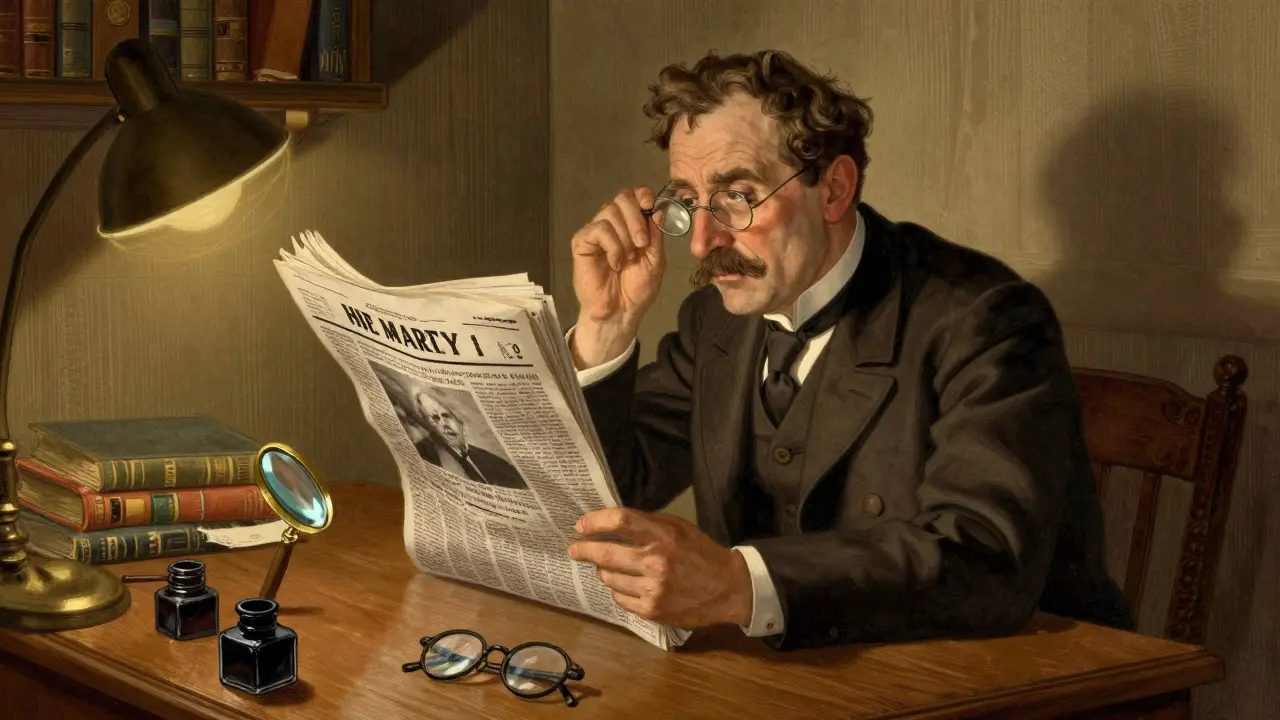
By your mid-40s, you might start holding your phone farther away to read text. Or you find yourself squinting at menus, medicine bottles, or your computer screen. This isn’t just bad lighting or tired eyes-it’s presbyopia. It’s not a disease. It’s not your fault. And it happens to everyone. If you’re over 40 and struggling to focus on close-up tasks, you’re not alone. In fact, 1.8 billion people worldwide are dealing with it right now, and that number is climbing to 2.1 billion by 2030.
What Exactly Is Presbyopia?
Presbyopia is the natural, unavoidable loss of your eye’s ability to focus on things up close. It’s caused by changes in the lens inside your eye. When you’re young, that lens is soft and flexible, like a rubber band. It changes shape easily to bring close objects into focus-whether you’re reading a book, threading a needle, or checking your watch. But as you age, the lens gets harder and thicker, like an old, stiff sponge. It can’t bend or adjust the way it used to. Light no longer focuses properly on the retina when you look at something near. That’s why words blur.
This isn’t the same as farsightedness. Farsightedness is about the shape of your eyeball. Presbyopia is about the lens aging. You can be nearsighted and still get presbyopia. You can be perfectly sighted at distance and still need reading glasses. It’s a universal part of aging-like gray hair or wrinkles. No eye exercises, no special diet, no supplements can stop it. As Dr. Emily Chew from the National Eye Institute says, it’s as inevitable as aging itself.
When Does It Start? What to Expect
Most people first notice symptoms between 40 and 45. It doesn’t happen overnight. It creeps in slowly. At first, you might just need brighter light to read. Then you start holding things farther away. By 50, you’re probably reaching for reading glasses more often than not. By 60, your eyes can barely focus on anything closer than 100 centimeters-about the length of a yardstick. That’s a big jump from when you were 15, when you could focus on something just 7 centimeters from your eyes.
The amount of correction you need grows over time. Around 45, you might need +1.00 diopters. By 55, it’s often +2.00. By 65, many people need +2.50 to +3.00. These numbers aren’t guesses-they’re based on decades of clinical data from the National Eye Institute and Mount Sinai. Your prescription will likely increase every 2 to 3 years until your early 60s, when it tends to stabilize.
Reading Glasses: The Simple Fix
For most people, reading glasses are the easiest and most affordable solution. You can buy them off the shelf at any drugstore, grocery store, or online. Prices range from $6 to $20. They come in +0.75 to +3.50 diopter strengths, in 0.25 increments. If you’re not sure what you need, try a few pairs. Hold a book at your normal reading distance. The lowest strength that makes the text clear is your starting point.
But here’s the catch: over-the-counter readers aren’t perfect. About 35% of people buy the wrong strength, which can cause headaches or eye strain. They also don’t correct for differences between your two eyes. If one eye is stronger than the other, or if you have astigmatism, you’ll need prescription lenses. Still, for occasional reading-checking labels, scrolling through your phone, flipping through a magazine-they work great.
Amazon has over 200,000 reviews for affordable reading glasses. The average rating is 4.1 out of 5. People love the convenience. But 22% of 1-star reviews mention headaches, blurry vision, or poor lens quality. That’s why cheap isn’t always better. If you’re using them daily, investing in a decent pair from a reputable brand makes a difference.
Progressive Lenses: The Seamless Alternative
If you already wear glasses for distance, reading glasses become a hassle. You’re always taking them off and putting them back on. That’s where progressive lenses come in. These are single lenses that give you clear vision at all distances-near, intermediate, and far-without visible lines.
They’re more expensive than regular bifocals, costing $250 to $450. But they look like regular glasses. No one can tell you’re wearing multifocals. The trade-off? There’s a learning curve. About 25% of first-time wearers feel dizzy or get peripheral distortion. It takes 2 to 4 weeks to adapt. You have to learn to move your head, not just your eyes, to find the right viewing zone.
Modern progressives have improved a lot. EssilorLuxottica’s Eyezen 2.0, launched in 2023, has a 30% wider near-vision zone based on data from 10,000 wearers. Johnson & Johnson’s Acuvue Oasys Multifocal contact lenses, approved in early 2023, offer 89% success in clinical trials. Still, even the best lenses don’t give perfect vision everywhere. Dr. George Witkin of NYU Langone says only 60% of patients get flawless near vision without compromise.
Surgical Options: Permanent Fixes?
For those tired of glasses or contacts, surgery is an option. There are a few choices:
- Monovision LASIK: One eye is corrected for distance, the other for near. About 85% of patients are satisfied, but 15% lose depth perception. Around 10-15% need a touch-up within five years.
- Refractive Lens Exchange: Your natural lens is removed and replaced with a multifocal implant. It’s like cataract surgery without the cataract. Costs $3,500 to $5,000 per eye. You’ll get permanent correction, but 25% report halos at night, and 15% notice reduced contrast sensitivity.
- Corneal Inlays (like Presbia’s Flexivue): A tiny lens is inserted into the cornea to improve near vision. Approved in Europe in 2022, it helped 78% of patients reach 20/25 near vision after a year.
- Conductive Keratoplasty (CK): Uses radio waves to reshape the cornea. Gives about 2.5 to 3.0 diopters of improvement. Less common now due to newer options.
Surgery isn’t risk-free. Endophthalmitis (a serious eye infection) happens in 0.04% of lens replacement cases. Dry eyes occur in 35% of LASIK patients. And not everyone is a candidate. Your eye doctor will need to check your cornea thickness, pupil size, and overall eye health before recommending surgery.
What Your Eye Doctor Will Check
If you’re noticing changes, don’t just grab a pair of readers. Get a comprehensive eye exam. Starting at age 40, the American Academy of Ophthalmology recommends a full eye checkup every 1 to 2 years. During the exam, your doctor will:
- Test your near and distance vision separately
- Measure your pupil distance (PD) to within 0.5mm accuracy
- Check for astigmatism, glaucoma, or macular degeneration
- Use cycloplegic drops to relax your eye muscles and get the true reading prescription
Without cycloplegic refraction, your near vision strength can be underestimated by 0.25 to 0.50 diopters. That might sound small, but it’s enough to cause daily strain. A basic exam costs $79 to $250 in the U.S., depending on location and provider.
What Works Best for You?
There’s no one-size-fits-all solution. Here’s how to decide:
- Try reading glasses first if you only need them occasionally and don’t wear distance glasses.
- Choose progressives if you already wear glasses and want one pair for everything.
- Consider monovision contacts if you’re active and dislike glasses-but test them first with trial lenses.
- Look at surgery only if you’re frustrated with glasses, have healthy eyes, and understand the risks.
One graphic designer from Florida, 52, switched to occupational progressive lenses with a 14mm corridor. He says it eliminated his computer screen strain and kept his distance vision sharp. That’s the kind of tailored solution that makes a real difference.
The Future of Presbyopia Correction
Research is moving fast. The National Eye Institute is testing a new eye drop called VP-025. Early trials show it can temporarily improve near vision by 1.0 to 1.5 diopters for up to 6 hours. That could mean no glasses for a few hours at a time-useful for meetings, reading, or driving at night.
The global market for presbyopia correction is worth $14.2 billion and growing. Online retailers like Warby Parker now offer free progressive trial kits. Optical chains are redesigning frames to better fit progressive lenses. The goal is to make correction easier, more comfortable, and more accessible.
But for now, the simplest, safest, and most proven solution remains the same: reading glasses. They’re not glamorous. They’re not high-tech. But they work. And they’re available to almost everyone, everywhere.
Is presbyopia the same as farsightedness?
No. Farsightedness (hyperopia) is caused by the shape of your eyeball being too short, making it hard to focus on close objects from a young age. Presbyopia is caused by the lens inside your eye becoming stiff as you age. You can be farsighted and get presbyopia, or nearsighted and still need reading glasses later in life. They’re different problems with different causes.
Can I prevent presbyopia with eye exercises or diet?
No. Despite claims online, no eye exercises, vitamins, or supplements can stop or reverse presbyopia. It’s a mechanical change in the lens caused by aging. The lens grows thicker and harder over time, like a tree adding rings. That’s not something you can fix with nutrition or workouts. The only proven solutions are corrective lenses or surgery.
Why do my reading glasses give me headaches?
Headaches from reading glasses usually mean the power is too strong, or your prescription isn’t right for both eyes. Over-the-counter readers are made with the same strength in both lenses. If one eye needs more correction than the other, or if you have astigmatism, your eyes strain to compensate. A proper eye exam with a doctor can fix this. Also, cheap lenses can have optical distortions that cause eye fatigue.
How often should I get new reading glasses?
Most people need a stronger prescription every 2 to 3 years between ages 45 and 65. After that, it usually stabilizes. But if you notice your current glasses aren’t helping anymore-text is still blurry, you’re holding things farther away-it’s time for a new exam. Don’t wait until you’re struggling. Getting the right strength early prevents eye strain and headaches.
Are progressive lenses worth the cost?
If you already wear glasses for distance, yes. They eliminate the need to switch between two pairs. But they’re not for everyone. About 25% of first-time wearers feel dizzy or have trouble with peripheral vision. Give them 2 to 4 weeks to adjust. If you still feel off, your fit might be wrong. Pupil distance, frame tilt, and how high you wear them all matter. A good optician will help you get it right.
Can I wear contact lenses for presbyopia?
Yes. Multifocal contact lenses are available and work well for many people. Brands like Acuvue Oasys Multifocal and Air Optix Aqua Multifocal have improved significantly. Another option is monovision: one contact for distance, one for near. About 80% of people adapt successfully, but 15% lose depth perception. Try trial lenses before committing.
What to Do Next
If you’re noticing trouble with near vision, don’t ignore it. Start with an eye exam. Don’t assume you know your prescription. Even if you’ve worn glasses for years, your needs change. A simple checkup can confirm whether it’s presbyopia or something else-like dry eyes or early cataracts.
Try over-the-counter readers for a week. See how they feel. If you’re using them daily, consider a prescription pair. If you’re already wearing distance glasses, ask your eye doctor about progressives. If you’re tired of glasses altogether, talk to a specialist about surgical options-but only after understanding the risks and alternatives.
Presbyopia doesn’t mean you have to give up reading, cooking, or using your phone. It just means you need the right tools. And those tools are more accessible, affordable, and effective than ever before.


Write a comment