

Uveitis is not just a red eye. It’s inflammation deep inside your eye - in the uvea, the middle layer that feeds the retina and controls pupil size. Left untreated, it can blur your vision, cause permanent damage, or even lead to blindness. This isn’t rare. Uveitis is the third leading cause of blindness worldwide. And yet, many people ignore the early signs, thinking it’s just eye strain or allergies. That’s dangerous.
What Exactly Is the Uvea?
The uvea isn’t one thing. It’s three parts working together: the iris (the colored part), the ciliary body (which helps focus your lens), and the choroid (a blood-rich layer behind the retina). Together, they supply oxygen and nutrients to the eye’s most critical structures. When inflammation hits any of these, it’s uveitis. The location of the inflammation determines the type, symptoms, and treatment.Four Types of Uveitis - And How They Differ
There are four main types, each with different risks and warning signs.- Anterior uveitis - This is the most common, making up 75-90% of cases. It affects the front of the eye - the iris and ciliary body. Symptoms come on fast: intense redness, eye pain that gets worse when reading, sensitivity to light, and blurry vision. It often hits just one eye. If caught early, it responds well to eye drops.
- Intermediate uveitis - This targets the vitreous, the jelly-like fluid in the center of the eye. It’s less painful but causes floaters - those dark spots or squiggles that drift across your vision. Blurry vision is common. It often lasts longer, sometimes years, and can come back. It’s sometimes called pars planitis.
- Posterior uveitis - This affects the retina and choroid at the back of the eye. Symptoms develop slowly. You might not notice pain, but your vision gradually fades. Floaters and blurred vision are common. It often affects both eyes and carries the highest risk of permanent damage because it directly harms light-sensing tissue.
- Panuveitis - This is the worst-case scenario. Inflammation hits all layers at once. You’ll see symptoms from all the above: pain, redness, floaters, and severe vision loss. It’s rare but serious.
What Causes Uveitis?
In about one-third of cases, doctors can’t find a cause. That’s called idiopathic uveitis. But when there is a cause, it usually falls into three buckets.- Autoimmune diseases - Your immune system attacks your own eye tissue. Conditions like ankylosing spondylitis, multiple sclerosis, sarcoidosis, and reactive arthritis are common triggers.
- Infections - Viruses like herpes simplex or shingles (herpes zoster), bacteria like syphilis, or parasites like toxoplasmosis can trigger inflammation. CMV retinitis, common in people with weakened immune systems, is another example.
- Trauma or surgery - A blow to the eye, a penetrating injury, or even eye surgery can spark inflammation as the body tries to heal.
It’s not just about the eye. Uveitis can be the first sign of a hidden systemic disease. That’s why doctors don’t just look at your eye - they ask about joint pain, skin rashes, or unexplained fevers.
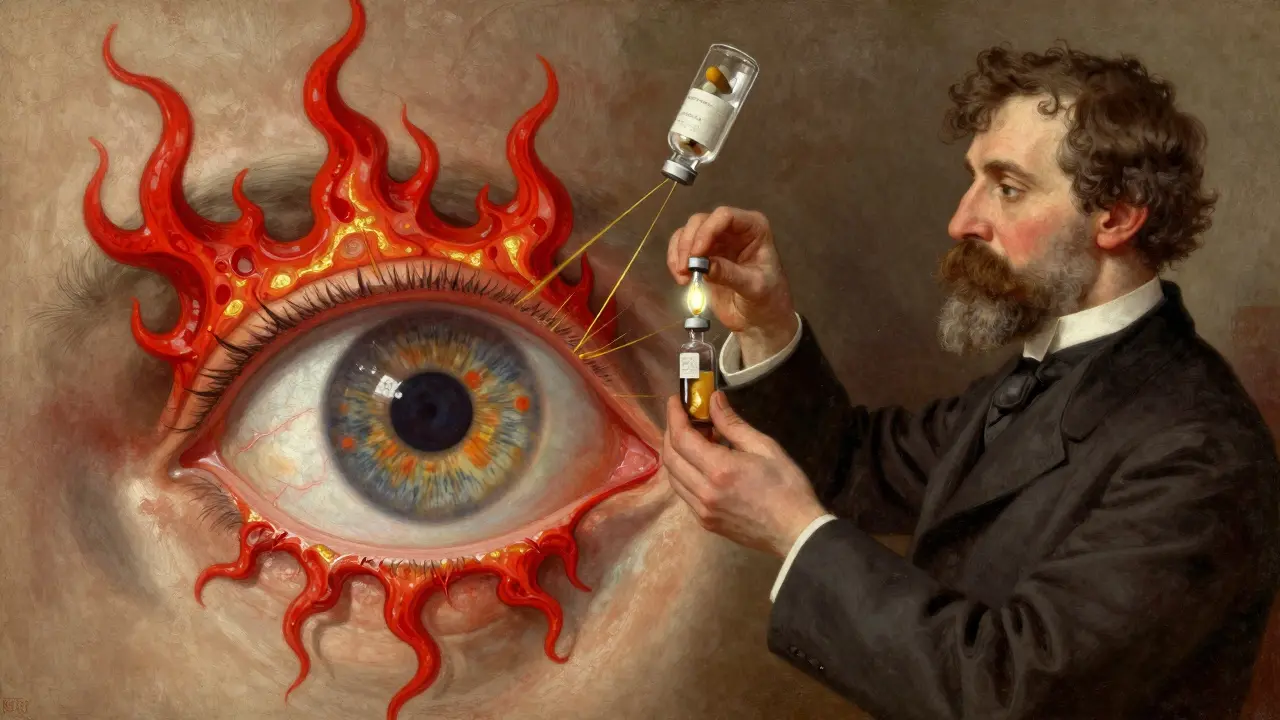
Why Steroid Therapy Is the First Line of Defense
The goal is simple: stop the inflammation before it scars your eye. Corticosteroids - powerful anti-inflammatory drugs - are the gold standard. But how you get them depends on where the inflammation is.- For anterior uveitis - Steroid eye drops, like prednisolone acetate 1%, are used. You’ll start with drops every hour or two, then slowly taper off over weeks. Pain and redness often improve in days.
- For intermediate uveitis - Eye drops don’t reach deep enough. Doctors may inject steroids around the eye (periocular) or use an implant that slowly releases medication inside the eye (intravitreal). Oral steroids are also common.
- For posterior uveitis and panuveitis - Oral steroids like prednisone are usually needed. In some cases, a slow-release implant is placed directly into the eye. For chronic cases, doctors may add steroid-sparing drugs like methotrexate or azathioprine to reduce long-term steroid use.
Why not just use drops for everything? Because steroids need to reach the inflamed tissue. The front of the eye is easy to treat. The back? That’s like trying to soak a sponge at the bottom of a swimming pool with a spray bottle. You need stronger delivery.
The Risks of Steroid Treatment - And How to Manage Them
Steroids work, but they’re not harmless. Long-term use can cause:- Cataracts - Clouding of the eye’s natural lens. Up to 30-40% of long-term steroid users develop them.
- Steroid-induced glaucoma - Increased eye pressure that damages the optic nerve. This can happen even if you never had high pressure before.
- Systemic side effects - Weight gain, mood swings, high blood sugar, bone thinning - especially with oral steroids.
That’s why treatment isn’t just about starting steroids - it’s about knowing when to stop. Doctors aim for the lowest effective dose for the shortest time. If inflammation comes back, they’ll switch to steroid-sparing drugs. These don’t work as fast, but they’re safer for long-term use.
When to See a Doctor - Right Now
Don’t wait. Uveitis is a medical emergency. If you have:- Sudden eye redness with pain
- Blurred vision that doesn’t clear up
- Floaters that appear out of nowhere
- Extreme sensitivity to light
- see an eye doctor within 24 hours. Delaying treatment increases your risk of permanent vision loss. Even if symptoms fade on their own, the inflammation may still be active. Uveitis can flare up again without warning.
Some people think, ‘I had red eyes before - it went away.’ But uveitis doesn’t always look like a simple pink eye. It’s deeper. It’s silent until it’s too late.
What Happens If It’s Not Treated?
Untreated uveitis doesn’t just cause blurry vision. It causes structural damage:- Synechiae - The iris sticks to the lens or cornea, distorting the pupil and blocking fluid flow.
- Macular edema - Swelling in the center of the retina, the part you use to read and recognize faces.
- Retinal detachment - The retina peels away from the back of the eye.
- Glaucoma - Permanent optic nerve damage from high pressure.
- Cataracts - Clouding from inflammation or steroid use.
These aren’t theoretical risks. They’re documented outcomes. The Lions Eye Institute calls uveitis ‘a potentially sight-threatening problem’ - and they’re right. Up to 30% of people with chronic uveitis lose significant vision.
What You Can Do
You can’t prevent all uveitis, especially if it’s tied to an autoimmune disease. But you can protect your vision:- Know the symptoms. Don’t brush off redness or floaters.
- See an ophthalmologist - not just your GP - if you suspect uveitis.
- Follow your treatment plan. Don’t stop steroid drops just because you feel better.
- Get regular eye checkups, even after symptoms fade.
- Report any new symptoms - even if they seem minor.
Uveitis isn’t something you can treat with over-the-counter drops or rest. It needs expert care. And the sooner you get it, the better your chances of keeping your sight.
Can uveitis go away on its own?
Sometimes, yes - but that doesn’t mean it’s gone. Symptoms may fade, but inflammation can still be silently damaging your retina or optic nerve. Stopping treatment too early often leads to复发 (recurrence). Always follow up with your eye doctor, even if you feel fine.
Are steroid eye drops safe for long-term use?
Not without monitoring. Long-term use can raise eye pressure and cause cataracts. That’s why doctors don’t prescribe them indefinitely. If you need more than a few months of steroids, your doctor will likely add a steroid-sparing medication to reduce side effects. Regular eye pressure checks are essential.
Can uveitis affect both eyes?
Yes. Anterior uveitis usually affects one eye, but intermediate, posterior, and panuveitis often involve both. If you’ve had uveitis in one eye, you’re at higher risk for it in the other. That’s why ongoing monitoring matters - even if only one eye is symptomatic now.
Is uveitis contagious?
No. Uveitis itself isn’t contagious. But if it’s caused by an infection like herpes or syphilis, those underlying infections can be passed to others. You can’t catch uveitis from someone else’s eye, but you can catch the virus or bacteria that might trigger it.
What tests are used to diagnose uveitis?
An eye doctor will use a slit-lamp microscope to examine your eye in detail. They may also check your eye pressure, dilate your pupils to look at the retina, and order blood tests or imaging like an OCT scan to check for swelling or damage. If a systemic disease is suspected, you might be referred to a rheumatologist.
Can children get uveitis?
Yes. Juvenile idiopathic arthritis is a common cause in kids. Children often don’t complain of pain or vision changes, so uveitis can be missed. Regular eye screenings are critical for kids with autoimmune conditions, even if they have no eye symptoms.


Write a comment