

Warfarin and NSAID Bleeding Risk Calculator
Assess Your Bleeding Risk
This tool calculates your bleeding risk when taking warfarin with NSAIDs based on clinical data. Select your factors below:
Your Risk Assessment
When you're on warfarin, even a simple pain reliever can turn dangerous. That’s not scare tactics-it’s science. Warfarin, a blood thinner used for decades to prevent clots in people with atrial fibrillation, deep vein thrombosis, or artificial heart valves, works by blocking vitamin K. That slows down your body’s ability to make clotting factors. But when you add an NSAID-like ibuprofen, naproxen, or diclofenac-for a sore knee or headache, you’re not just doubling up on pain relief. You’re stacking two separate mechanisms that both make bleeding more likely. And together, they don’t just add up-they multiply.
How Warfarin Works (And Why It’s Already a Tightrope)
Warfarin doesn’t thin your blood like water. It disrupts a specific chemical process in your liver. Vitamin K is needed to activate clotting factors II, VII, IX, and X. Without enough active vitamin K, these factors stay incomplete and useless. That’s how warfarin prevents dangerous clots. But because it’s so precise, even small changes in your diet, other medications, or health status can throw off your balance. That’s why doctors monitor your INR-a blood test that measures how long it takes your blood to clot. A normal INR is around 1.0. For most people on warfarin, the target is between 2.0 and 3.0. Go above 4.0, and bleeding risk spikes. Drop below 2.0, and clots become more likely.
Keeping that number stable is hard enough on its own. Add an NSAID, and everything gets riskier.
How NSAIDs Make Things Worse
NSAIDs-nonsteroidal anti-inflammatory drugs-work by blocking enzymes called COX-1 and COX-2. COX-2 causes inflammation and pain. COX-1 protects your stomach lining and helps platelets stick together. When NSAIDs block COX-1, two things happen:
- Your platelets can’t clump properly to seal small cuts.
- Your stomach loses its natural protective mucus layer.
This is why people on NSAIDs often get stomach ulcers. But when you’re also on warfarin, your blood can’t clot well to begin with. Now, your platelets are sluggish, your stomach lining is raw, and your clotting factors are already low. It’s a perfect storm. The result? Bleeding doesn’t just happen more often-it happens faster and harder.
The Numbers Don’t Lie
Studies show this isn’t theoretical. A 2019 analysis from the European Society of Cardiology found that people taking warfarin and an NSAID together had more than double the risk of bleeding compared to those on warfarin alone. But not all NSAIDs are equal:
- Ibuprofen: 1.79 times higher bleeding risk
- Diclofenac: 3.3 times higher
- Naproxen: 4.1 times higher
Naproxen isn’t just risky-it’s the riskiest common NSAID when paired with warfarin. Meloxicam, often thought to be safer because it’s “selective,” was also flagged in a 2010 study as a strong predictor of dangerous INR spikes. Even low-dose aspirin, which is technically an NSAID, carries this risk because it irreversibly blocks platelet function.
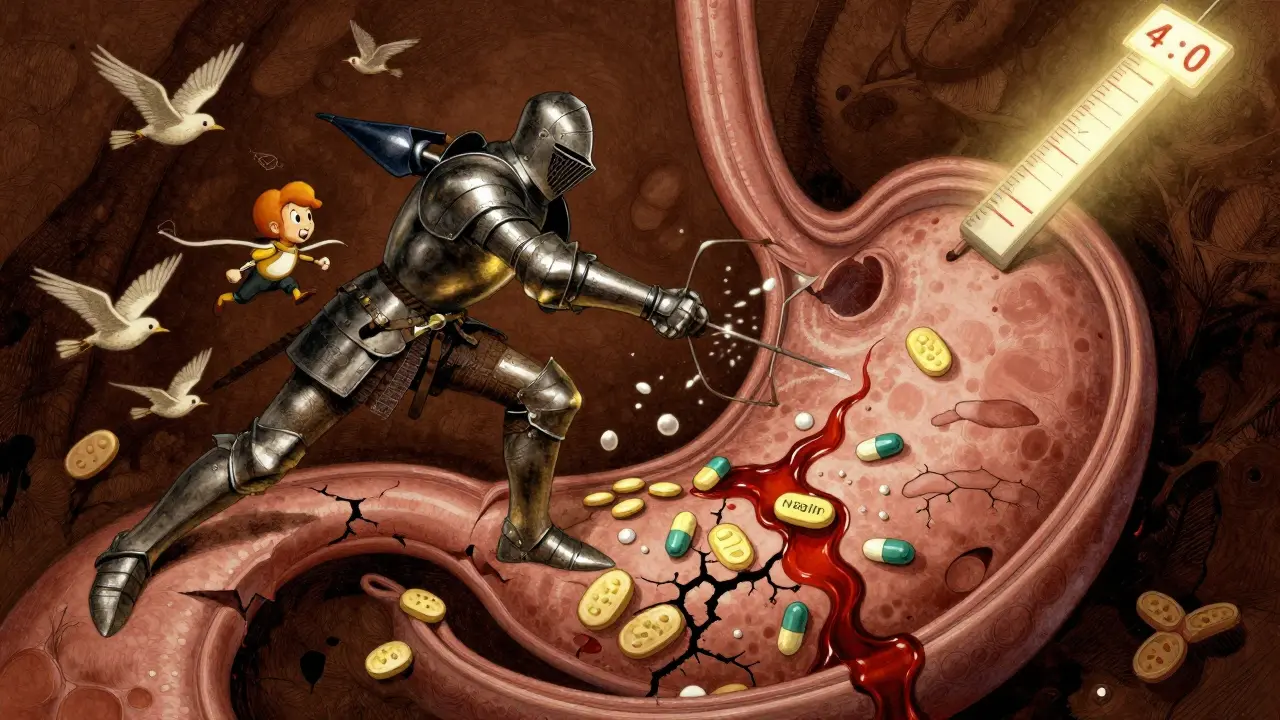
The bleeding isn’t limited to your stomach. Brain bleeds (intracranial hemorrhage) were 3.22 times more likely. Lung bleeds went up 36%. Urinary tract bleeds rose 57%. And almost one in three people on this combo developed anemia from slow, hidden blood loss.
Who’s Most at Risk?
Not everyone on warfarin who takes an NSAID will bleed. But some people are far more vulnerable:
- Those on high-dose warfarin (>40 mg per week)
- People taking three or more other medications that interact with warfarin
- Those with a low baseline INR (meaning their blood clots too easily before the NSAID hits)
- Patients with a history of ulcers or GI bleeding
- Older adults, especially over 75
One study found that 39 out of 98 warfarin users who added an NSAID saw their INR jump by 15% or more-enough to trigger urgent medical action. That’s nearly 40% of patients. And in real life, many never even tell their doctor they’re taking ibuprofen for back pain.
What About Newer Blood Thinners?
You might think switching to a DOAC-like apixaban, rivaroxaban, or dabigatran-makes this safer. It doesn’t. While DOACs don’t affect INR, they still increase bleeding risk when mixed with NSAIDs. A 2018 study found that people on dabigatran who took NSAIDs had higher rates of major bleeding, hospitalization, and GI bleeds than those who didn’t. The pattern is the same: NSAIDs hurt your stomach and slow platelets. Your blood thinner, no matter the name, can’t compensate for that.

What Should You Do Instead?
For most people on warfarin, acetaminophen (paracetamol) is the safest go-to for pain or fever. Up to 3,000 mg per day is generally safe for adults, as long as you don’t drink alcohol heavily. It doesn’t affect platelets or the stomach lining. Topical creams like diclofenac gel (applied to the skin) are also a better option-they deliver the drug where it’s needed without flooding your bloodstream.
For chronic pain, physical therapy, heat packs, or even acupuncture can help reduce reliance on pills. If you absolutely need an NSAID-for example, after surgery or severe arthritis-talk to your doctor first. They may:
- Prescribe a proton pump inhibitor (PPI) like pantoprazole to protect your stomach
- Use the lowest effective dose for the shortest time possible
- Check your INR within 3 to 5 days of starting the NSAID
- Switch you to a different painkiller if the risk is too high
And never, ever take an NSAID without telling your pharmacist or doctor you’re on warfarin. Even over-the-counter products like Advil, Aleve, or Motrin can be dangerous.
What to Watch For
If you’re on warfarin and accidentally took an NSAID, or if your doctor says it’s okay for now, know the signs of bleeding:
- Bright red or black, tarry stools
- Unusual bruising, especially large or painful ones
- Bleeding gums when brushing your teeth
- Heavy or prolonged menstrual bleeding
- Headaches, dizziness, vision changes (could mean brain bleed)
- Dark urine or blood in urine
- Unexplained weakness or fatigue (sign of anemia)
If you notice any of these, call your doctor or go to the ER. Don’t wait. Bleeding from this combo can be silent until it’s life-threatening.
Why This Keeps Happening
Despite decades of warnings, a 2022 study found that nearly 29% of people on warfarin still got an NSAID prescription within a year. That’s almost one in three. Why? Because patients don’t realize OTC painkillers count. Because doctors assume the patient isn’t taking them. Because the pain is real, and the risk feels distant.
This isn’t about fear. It’s about awareness. Warfarin is a powerful tool. But it’s not a magic bullet. It demands respect-and careful choices when it comes to other meds.
If you’re on warfarin, your pain management plan should be as carefully planned as your anticoagulation. Talk to your doctor before taking anything new-even a bottle of ibuprofen from the cupboard. Your next INR test might depend on it.


Write a comment